
Cordless and corded electric chainsaws solve different customer problems. A cordless saw removes the power lead and gives mobility, but adds battery-system cost, runtime planning and shipment questions. A corded saw avoids battery management, but its usable area depends on a suitable electrical supply and cable arrangement. An importer should select by application and channel, not by a blanket claim that one format is more powerful or safer.
This comparison helps B2B buyers define a range brief. It does not prescribe chainsaw use, and it does not imply that either format is suitable for every cutting task. The approved manual and local workplace requirements remain essential.
Start with the cutting job and location
Ask whether the customer is trimming small branches near a building, maintaining a garden with scattered work points, preparing logs in a fixed yard or doing occasional property maintenance. Frequency, wood size and distance from power affect the format choice. A corded saw can be practical in a controlled area with appropriate supply; a cordless saw can reduce lead management when the work is spread out.
Do not compare only bar length or motor wattage. A useful application profile includes expected cut size, number of cuts, environment, user experience and other tools already owned. A battery platform may make a cordless saw more attractive if the retailer sells compatible drills and other tools. But a proprietary platform can create stock complexity if batteries are difficult to replace.
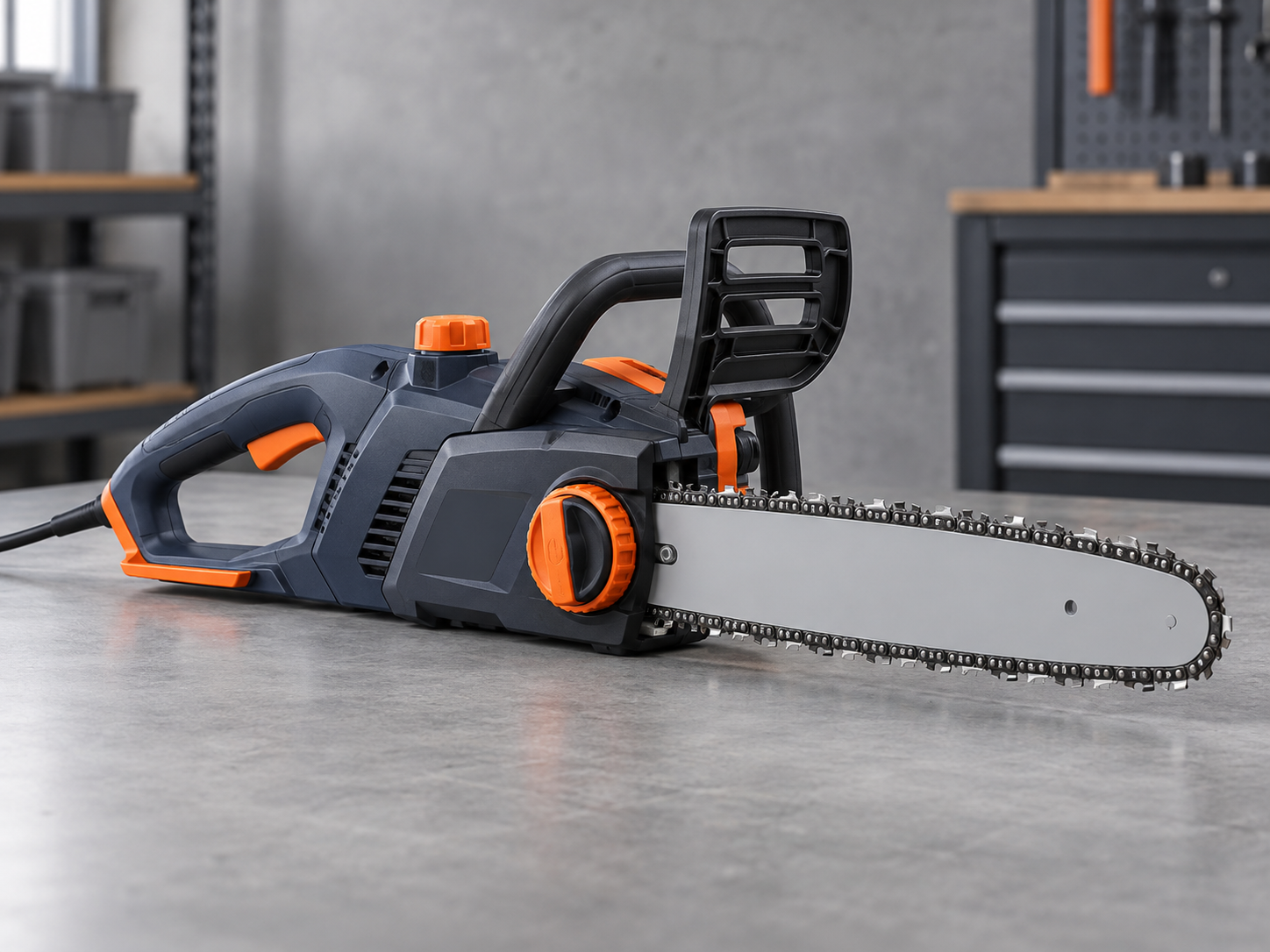
Caption: The working location and power arrangement shape the corded-versus-cordless decision.
Understand the power-system trade-off
A corded saw draws from an external electrical supply. Buyers need to examine plug type, rated voltage, cable length, instructions and any destination-market requirements. Extension-lead use should follow the approved manual and applicable local rules. A product photo should not show unsafe cable routing through a cutting area.
A cordless saw depends on a specified battery and charger combination. Its performance and runtime vary with pack capacity, condition, temperature and workload. “Up to” cut-count claims need a defined test method and material; do not copy a headline from another model. The battery-and-charger kit guide covers the broader kit-planning principles that also apply here.
For both types, compare the actual saw with the same approved bar-and-chain configuration and representative wood. Record whether the saw starts, cuts and handles as expected in the target application. Do not infer sustained performance from a few unloaded revs.
Compare total customer cost
The shelf price can be misleading. A cordless bare tool may look inexpensive until a battery and charger are added; a complete kit costs more and may require replacement packs over time. A corded saw may have a lower system entry cost but can require suitable power access and cable management. Ask for quotes in clearly defined configurations.
Specify what is in the box: saw, bar, chain, cover, battery, charger, oil if included and any assembly tool. If a battery is shown in marketing imagery but sold separately, label that clearly. Retailers should be able to tell customers the full cost of a usable setup before checkout.
Spare batteries and chargers should have identifiable model numbers, an availability plan and verified compatibility. A replacement pack that fits mechanically but lacks approval for the saw is not a responsible recommendation. The power-tool spare-parts guide explains how to plan model-level support.
Consider shipping and compliance early
Cordless packs introduce transport requirements that can affect quotation timing and freight options. The International Air Transport Association's 2026 lithium-battery guidance explains how battery configuration and watt-hour information enter air-shipping decisions. Requirements change and depend on exact shipment details; a qualified freight partner should confirm the current route.
The lithium-battery shipping guide provides a buyer checklist for the pack, documents and carrier discussion. Do not assume that shipping a battery installed in a saw is equivalent to shipping spare packs. For corded models, check electrical rating, plug and destination-market documentation rather than assuming that avoiding batteries eliminates compliance work.
Mid-article sourcing CTA: Deciding which power format to stock? Send your market, customer task and preferred kit contents for a comparable corded and cordless sample brief.
Keep cutting-system support consistent
Cordless or corded, the saw still needs a compatible bar and chain, correct tension and bar oil. Review the chain-tensioning guide and oil-system guide when selecting the full range. A mobility advantage means little if the customer cannot source a replacement chain.
Ask suppliers for bar, chain, tensioner and oil-system part IDs on both formats. If the parts are shared, verify the exact compatibility rather than assuming it. Shared consumables can simplify retail stock and service, but only when the approved configurations genuinely match.
Test user handling, not just cutting speed
With suitable supervision and protective measures, evaluate balance, mass, controls and setup. Cordless weight depends on the battery installed; test with the pack the kit will actually include. Corded handling includes the cable route and strain relief. Ask whether the operator can keep the tool controlled in the work positions the retail imagery suggests.
Record the wood, chain condition, oil, battery charge or electrical supply, and operator. These details make observations comparable and prevent a demo cut from turning into an unsupported performance promise. If a supplier claims a specific cut count or duty cycle, request the test protocol and repeatability evidence for the exact model.
Plan a comparable buyer trial
Put the two formats into a defined trial rather than comparing advertising clips. Choose representative wood pieces, prepare each saw with its approved bar, chain and oil, and use an operator who can follow the safe-work method. Record the material, cut type, chain condition, battery and charger details for the cordless model, and supply conditions for the corded model. Note handling and setup observations separately from cutting performance.
If the channel sells to homeowners, include a supervised first-use setup review. Can a new customer identify whether the battery and charger are supplied? Is the cable or battery latch easy to understand? Are oil filling and chain checks visible in the instructions? A tool that cuts well in expert hands can still generate returns because the retail package is unclear.
Do not publish an absolute runtime or “cuts per charge” figure from a single trial. Such claims depend on wood species, diameter, chain sharpness, pack condition and technique. If a quantitative claim is commercially important, establish a repeatable method with sufficient samples and disclose the conditions.
Define separate stocking and service models
Corded and cordless saws create different stock needs. The corded range may require region-specific electrical variants and cable service procedures. The cordless range needs pack and charger availability, transport planning and end-of-life battery handling. Both need bars, chains, oil-system parts and technical support. Compare these obligations before deciding that one format is “simpler.”
For a retailer already committed to a compatible battery platform, a cordless saw can strengthen the range, but compatibility needs verified model-by-model. A distributor entering a market with no pack infrastructure may find a corded saw easier to support initially. This is a commercial inference, not a universal performance ranking.
If both formats will be stocked, use distinct model names and box artwork. A listing with identical images except for the cable can confuse customers about kit contents. A clear comparison chart should show power source, included battery or charger, approved bar configuration and intended application without implying that either saw is suitable for work beyond its manual.
Account for outdoor conditions without making broad claims
Both formats may be used outdoors only within the approved model's instructions and applicable electrical or battery limitations. A buyer should ask about expected rain exposure, storage temperature, wood condition and the distance between work points. Do not call a saw “all-weather” based only on a rugged housing photograph. Obtain the actual rating and instructions if the supplier proposes an environmental-resistance claim.
Corded models need a power arrangement suited to the market and work location. The importer should check plug and voltage variants, cable strain relief and the instructions for extension leads or protective devices where applicable. Avoid showing a cable crossing the cut path in application imagery. The retailer should be able to explain the required supply without improvising local electrical advice.
Cordless models introduce battery temperature and charging considerations. A cold or hot pack can behave differently from the one used in a showroom demonstration. Ask the supplier for the approved operating and charging conditions, then ensure the product copy does not promise a fixed cut count independent of environment. Stocking a second battery may help some customers, but only if it is an approved pack and the shipping plan accounts for it.
Build a product-page comparison customers can use
List each model's power source, actual box contents, approved bar-and-chain configuration, weight with the intended battery where relevant, and the user task it was tested for. Do not place a cordless runtime next to a corded power rating as if they are the same metric. If quantitative cut performance is quoted, disclose the wood and test conditions.
Use the product-page FAQ to address practical objections. For cordless: is a battery included, what charger is required, and where can a spare pack be ordered? For corded: what electrical rating and plug are supplied, and what does the manual say about the working area? For both: which chain and bar replacements are approved, and what oil is needed before use?
Finally, monitor post-launch questions by format. If cordless buyers frequently discover the battery is not included, revise imagery and copy. If corded buyers report cable-length frustration, review the application's fit rather than making an unsupported “better reach” claim. Real field questions can refine the assortment more effectively than a blanket corded-versus-cordless ranking.
Example: range planning for two customers
Consider a property-maintenance dealer serving customers with fixed work areas near buildings, and a garden retailer serving buyers who move around large plots. The former may find a corded saw compelling if suitable power access and cable management are available. The latter may prefer a cordless kit with a clear spare-battery plan. These are plausible buying patterns, not universal rules; customer interviews and sample trials should decide the actual range.
Ask each channel for the average work session and whether buyers already own compatible batteries. A tool-only cordless SKU can be efficient for an established platform customer but frustrating for a new buyer. A corded SKU may be affordable but impractical where power access is uncertain. Show the complete usable cost and the parts the buyer must provide.
Run separate logistics scenarios. The cordless kit needs battery information and carrier review; the corded tool needs region-specific electrical configuration and documentation. Both require chains, bars and oiling support. Put these costs into the assortment comparison before declaring one format the cheaper route.
A balanced sales conversation
A salesperson can ask four questions: where will the work happen, how long will a typical session last, what wood and cut sizes are expected, and what battery or electrical system does the customer already have? The answers can direct the buyer to a suitable model or reveal that neither quoted saw fits the task. This is more useful than “cordless is modern” or “corded has unlimited runtime.”
The product page should avoid unsupported equivalence claims. A cordless saw may perform well in a defined task, but the battery discharge and temperature matter. A corded saw has continuous external supply but still has duty, handling and cutting-system limitations. Both require trained use. Honest explanations help retailers set expectations and reduce inappropriate purchases.
Final approval questions
For the corded model, confirm the market voltage, plug, cable, manual and intended work environment. For the cordless model, confirm the battery and charger IDs, included pack count, transport documents and replacement supply. For both, check the approved bar, chain, tensioner and oil system. A comparison is only fair when each saw is presented as a complete usable product.
Then review the retail messages. “Cordless” should not imply unlimited mobility if a spare pack is unavailable. “Corded” should not imply unlimited duty or universal electrical suitability. Name the customer task and the conditions under which each tool was evaluated. A precise explanation helps a buyer choose without overstating either format.
Frequently asked questions
Is a cordless chainsaw always better for outdoor work?
No. It offers mobility, but battery capacity, task duration, cost and spare-pack availability matter. A corded saw can suit some controlled outdoor locations with appropriate supply and setup.
Can a buyer compare models by bar length alone?
No. Review cutting-system compatibility, power format, actual application performance, controls, oiling and service parts.
Does a cordless saw always ship more easily with the battery installed?
No. Transport classification depends on the exact battery and packing configuration, route and current carrier rules. Confirm with a qualified freight provider.
What should a retail box-contents list include?
List the saw, bar, chain, cover, battery, charger, assembly tool and oil only if each is actually supplied.
Conclusion
Corded and cordless electric chainsaws are not substitutes in every customer scenario. Define the location and cutting job, compare complete usable kits, verify the cutting system and plan the required logistics and service support. That produces a range customers can understand and retailers can explain.
End-of-article CTA: Ask ToolViron for electric-chainsaw options and sample configurations. Include your market, user profile and whether you want bare-tool, corded or battery-kit pricing.

Caption: Compare complete usable configurations, not an incomplete bare-tool price with a full kit.
Images illustrate product and inspection topics; they are not documentary evidence of a specific ToolViron test or customer project. Confirm the exact model and market requirements before ordering.