
A power-tool importer can approve an attractive drill, grinder, chainsaw or planer sample and still struggle after launch if it cannot identify replacement parts. Service planning affects retailer confidence, warranty handling, customer reviews and the realistic cost of a private-label range. A usable plan names the exact parts, connects them to model revisions and explains who is qualified to replace them.
This guide helps B2B buyers build that plan before placing a first order. It does not promise that every part can or should be repaired by a consumer. Electrical and safety-critical work may require qualified service and market-specific procedures.
Start with the customer promise
Write down what your channel will actually offer: consumable replacements, a local repair partner, exchange during warranty, or return to an importer service centre. A broad “full after-sales support” phrase is not a plan. The service model determines which parts to stock, what data to collect and how long a retailer should expect a resolution to take.
Ask the supplier for model-specific manuals, exploded views, part numbers and a proposed service process during quotation—not after shipment. Separate parts used routinely by customers from parts handled only by authorised technicians. For example, a drill bit and a planer blade are consumables, while an electrical switch or chainsaw brake component may require controlled service.
The ToolViron product range covers several tool categories. A common service framework can be shared, but every SKU needs its own compatibility and revision data.
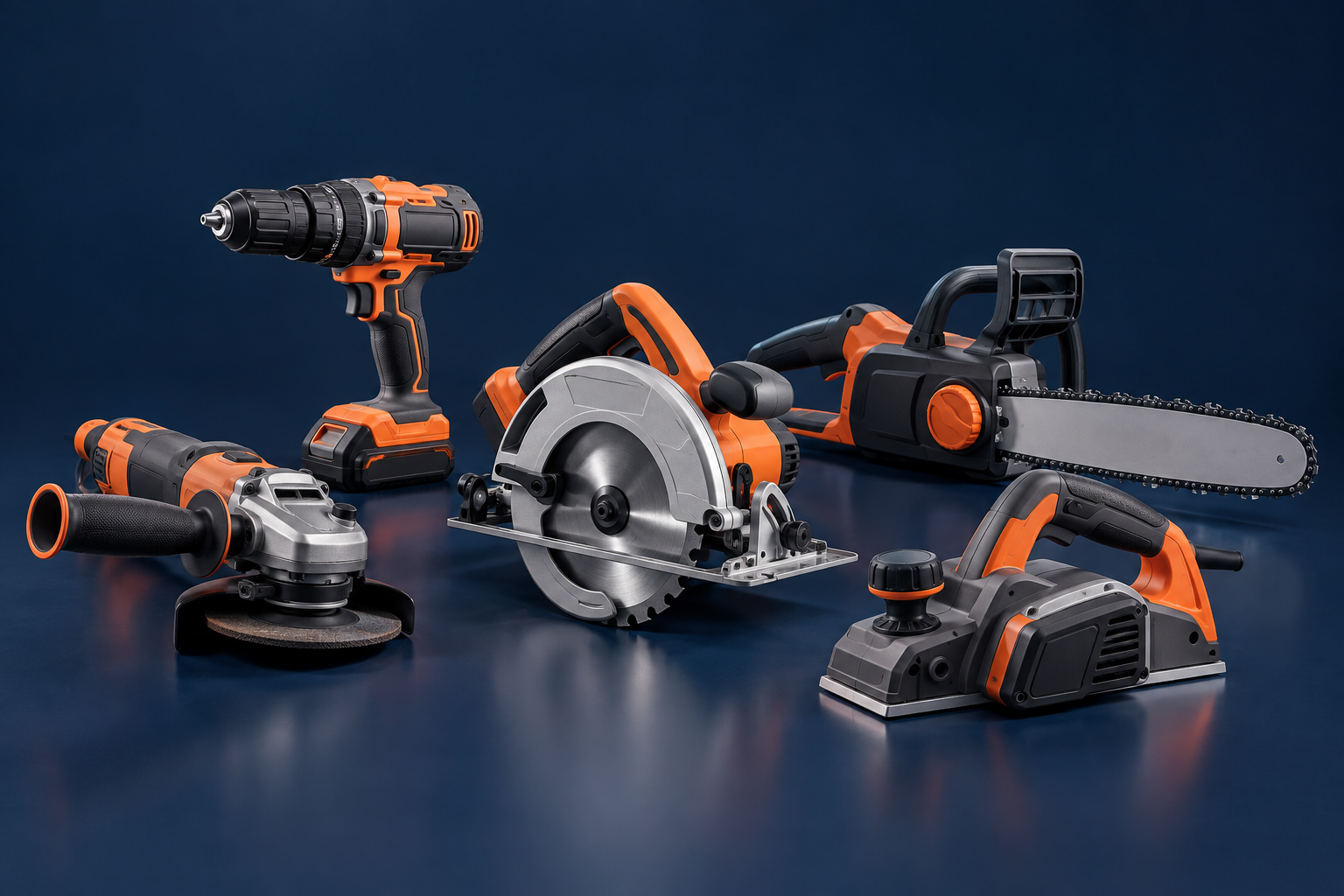
Caption: A service plan begins with exact model and part identification across the range.
Make a model-level parts register
For each SKU, create a register with model code, revision, approved components, part number, description, photograph, compatibility notes, minimum order and lead time. Keep the supplier's original drawing and any translated retail terminology together. A vague line such as “motor spare available” is insufficient if three similar motors exist.
Include the accessories needed to keep the tool useful: drill chucks or relevant service parts, grinder guards and flanges, chainsaw bars and chains, planer blades and guides, batteries and chargers where applicable. The exact list depends on design and market. The chainsaw replacement-parts guide gives a category-specific example.
Mark parts that are consumables, wear items, service-only assemblies or prohibited from customer repair. That classification helps a retailer answer questions without encouraging unsafe maintenance. Confirm which parts may be sold directly and which must be fitted by trained personnel.
Control revisions and substitutions
The most common service problem is a part that fits an earlier batch but not the current one. Maintain a link between serial or batch range and product revision. If a supplier changes a blade holder, charger connector or grinder flange, assess the effect on service parts and existing stock. A change that appears minor on the production line can create years of after-sales confusion.
Ask the factory to notify the importer of component changes before they enter production. Review the approved sample, bill of materials, manual, retail images and parts catalogue together. After approval, store a dated record. During shipment inspection, spot-check the relevant identifiers so the received goods can be matched to the service register.
Do not accept “equivalent” parts solely on visual similarity. A safety-related part may need design and compliance assessment; a blade or battery may need application testing. A substitution should be approved for the exact model and destination market before the service team recommends it.
Set sensible initial stock
There is no universal ratio of spare parts to tools. Start with the sales forecast, expected consumable demand, supplier lead time and local service arrangement. Retail channels with seasonal demand may need faster access to blades, chains or battery packs. Slow-moving structural parts may be supplied through a controlled order process rather than a large local inventory.
Track actual requests after launch. Record the issue category, model revision, part required and resolution time. This evidence can guide the next parts order and highlight design or instruction problems. A high number of “missing accessory” contacts may indicate pack-out or listing confusion rather than a mechanical defect.
Mid-article sourcing CTA: Preparing a private-label tool launch? Ask ToolViron for model-specific parts lists and a service discussion before approving your first shipment.
Build an intake and triage process
Retail and importer support should gather the model, batch or serial identifier, proof of purchase, symptom, photos and use context. It should then decide whether the question concerns setup, a consumable, a suspected defect or a safety-critical issue. A customer reporting a damaged guard or faulty brake should be directed to stop use and follow the approved service process, not given an improvised repair instruction.
Create short scripts for common questions. For a drill, ask which bit and material are involved before diagnosing performance. For a grinder, confirm the wheel and guard configuration. For a chainsaw, identify the bar, chain and oiling setup. For a planer, note blade condition and timber. The point is not to blame the user; it is to understand the product application and respond accurately.
Keep warranty terms aligned with the actual service capability and destination-market consumer law. Do not promise same-day repair or a replacement part availability period unless the supply chain can support it. The buyer should review legal obligations locally.
Verify support during supplier selection
Ask a potential supplier to respond to a realistic service request for the proposed model. Can it identify the correct part from a batch number? Does it supply a diagram and price? What is the lead time? Can it explain a revision change? This exercise reveals more than a generic promise to provide “spare parts.”
For safety or electrical components, ask what repair documentation and qualified-service conditions apply. For consumables, check whether replacement packaging can be sold through the retailer's channel. A service plan with only internal factory part codes may be unusable for overseas support staff.
The EU Commission's importer and distributor guidance explains that economic operators have responsibilities for products placed on the EU market. It is one jurisdiction's framework, not a global warranty template. Obtain market-specific advice for your route and product classification.
Connect service data to product improvement
When returns arrive, record cause and evidence rather than classifying every return as a manufacturing defect. A missing charger, unclear blade-installation instruction or incompatible accessory recommendation may require a packaging or content fix. A repeated switch or bearing failure may require technical investigation. Keep these pathways distinct.
Share anonymised field patterns with the supplier and ask for corrective action when appropriate. Track whether a revised part or manual reduces the issue in later batches. This is a more credible expression of experience than claiming perfect quality with no data. Buyers can speak honestly about a documented feedback loop without disclosing private customer information.
Measure service readiness before ordering
Create a small readiness scorecard for each proposed model. Can the supplier identify five likely spare parts from a photo and batch code? Is there a current manual and exploded view? Are replacement consumables packaged for the retailer's channel? Is a qualified repair route available for safety-critical or electrical components? Are quoted lead times written down? A model with unanswered questions should not be marketed as fully supported.
The scorecard is not a certification. It is a buyer tool for comparing operational risk. Keep the evidence beside the approved sample record so the service team does not have to repeat the investigation months later. If a supplier cannot provide part numbers until after production, ask how it will prevent revision confusion.
For a multi-category range, assign ownership. Procurement manages the supplier and parts contract; product management controls compatibility; customer support records field questions; quality reviews repeated defects; logistics handles returns and restricted items such as batteries. One person can hold several roles in a small company, but the duties should be explicit.
Plan the reverse flow of a product
Sending a faulty unit back is not always simple. A corded tool may require a standard return process, while a cordless kit can include a lithium battery subject to transport restrictions. Agree in advance who arranges carriage, which items are returned and what to do with a damaged battery. The lithium-battery shipping guide explains why a casual parcel label may not be appropriate for every pack.
Upon receipt, record condition and preserve the customer’s description. Do not immediately mix returned parts into service stock. A failure investigation may need the exact component and batch. After assessment, decide whether to repair, replace, refund or escalate according to the agreed warranty and local law. The output should update the service data, not disappear into a one-off email.
If the tool is not repairable economically, the importer still needs an environmentally responsible route for disposal or recycling in the destination market. Do not promise that every model is repairable forever, but do provide a practical way to handle end-of-life units and consumables.
Write a supplier service agreement with measurable terms
Ask the supplier to commit to a defined parts-list format, part-number continuity, change notification and response time for technical questions. If an availability period matters commercially, put it in writing with conditions rather than relying on a sales promise. Define what happens when an original part is discontinued: does the supplier propose a compatible successor, provide a final-buy notice, or support another remedy?
Include ownership of service documents. The importer needs the right to use manuals, diagrams and compatibility information to support products it has already sold, even if a later order moves to another supplier. Keep translated versions synchronised with the technical master. A service team working from an obsolete drawing may send the wrong component.
Agreement terms do not replace physical verification. Trial-order a small set of proposed spare parts, check them against the approved sample and record any mismatch. Repeat the exercise when a model revision changes. This test reveals whether the supplier's administrative system is as reliable as its sales promise.
Use service evidence in the next buying decision
After a selling season, compare models using more than return rate. Measure time to identify a part, time to obtain it, percentage of first shipments that contain the right part, and recurring questions that indicate unclear instructions. A model with few mechanical failures can still be expensive to support if every consumable requires manual detective work.
Bring this evidence to the next supplier review. Ask whether a component can be standardised across SKUs, whether a manual can be clearer, or whether a missing accessory should be included. The best improvement may be packaging rather than mechanical redesign. Document the decision and check its effect in the next batch.
Avoid converting internal observations into unsupported marketing claims. “We maintain model-specific parts records” is a process statement if it is true. “Zero downtime” is an outcome promise the importer cannot control. Trust grows when the site explains practical support accurately and gives buyers a way to request exact documents.
A minimum data set for each product page
The public page does not need a full internal service manual, but it should provide enough information to route a customer accurately. Include the model code, clear box contents, approved consumable references where relevant, a link to the correct manual and a support contact. If several versions share a marketing name, provide a way to distinguish them. A customer should not have to send a photograph of the entire tool to find a replacement blade or chain.
Behind the page, maintain the full parts register, revision history and service-only notes. Customer support can use that record to answer questions without exposing unsafe repair instructions publicly. When a model is updated, update the website and spare-parts listing at the same time as the production specification.
This connection between product data and service data is easy to neglect in a fast launch. It is also where a B2B buyer can create durable trust: the website remains useful after the first sale, not only during the first inquiry.
Final launch-readiness check
Before the first shipment, ask a retailer to simulate three support requests: a replacement consumable, a suspected defect and a missing accessory. Can the team identify the model, route the request correctly and give a truthful time estimate? If every case depends on an informal message to the factory salesperson, the service system is not yet ready.
Keep a named owner for document updates and part substitutions. The factory may improve a design during production, but the importer must know whether spare stock, manuals and website compatibility information change. Date the service register and keep the old revision accessible for existing customers.
A strong after-sales plan does not require claiming every fault can be repaired instantly. It requires traceability, honest availability information and a process that treats safety-related issues with appropriate priority. Those are concrete capabilities a B2B buyer can inspect during supplier selection.
Frequently asked questions
Which parts should an importer stock first?
Prioritise model-specific consumables and frequently requested accessories, then consider supplier lead time and the service model. There is no universal list or percentage for all categories.
Can a visually similar battery or blade be recommended?
Not without confirmed compatibility for the exact tool and revision. Mechanical fit alone does not establish electrical or cutting-system suitability.
Should customers repair all components themselves?
No. Follow the approved manual and local rules. Electrical and safety-critical components may require qualified service.
What information helps a service team identify the right part?
Model and revision or batch ID, symptom, photos and the part register are the minimum practical starting point. A dated compatibility matrix helps avoid wrong-part shipments.
Conclusion
After-sales support is a designed system. Define the channel promise, obtain model-level parts data, control revisions and collect service evidence after launch. This reduces avoidable delays and gives buyers a more realistic view of total product cost.
End-of-article CTA: Send ToolViron your product categories, market and expected service model to discuss catalogues, sample parts lists and a practical private-label support plan.

Caption: Traceable part records let overseas service teams identify the correct component.
Images illustrate product and inspection topics; they are not documentary evidence of a specific ToolViron test or customer project. Confirm the exact model and market requirements before ordering.