
A cordless drill kit is a system: tool body, removable battery, charger, power supply, instructions, packaging and a plan for replacement parts. A quotation for the drill body alone does not describe what a retailer will sell or what an installer will use on day one. Importers should specify the complete kit before comparing prices, sampling or booking a shipment.
This guide is for buyers considering a cordless programme. ToolViron’s published product range should be consulted for currently offered models; this article does not assert that every battery platform or configuration is available. It sets out the questions that make a supplier conversation precise, especially when an existing corded range is being expanded.
Define the customer’s daily work
Start with tasks, not battery voltage. A home user who assembles furniture a few weekends a year has a different charging and spare-battery need from a mobile installer working across sites. Record typical hole and fastener work, how long the tool is away from mains power, whether a charger can be used during the day, and what the customer already owns. This determines whether one battery is enough for the offer or whether a two-battery kit has a clear benefit.
The product application should also define where the drill will be stored and transported. A compact carton may suit an online channel; a case may matter to trade customers who move tools between jobs. Neither packaging option should be assumed to be standard. Include it in the requested configuration and quote.
Where a buyer sells other cordless tools, ask whether the battery is intended to be part of a broader platform. Battery compatibility is a commercial promise that must be supported by the actual interface and approved models. Avoid implying interchangeability from a shared nominal voltage or similar physical appearance.
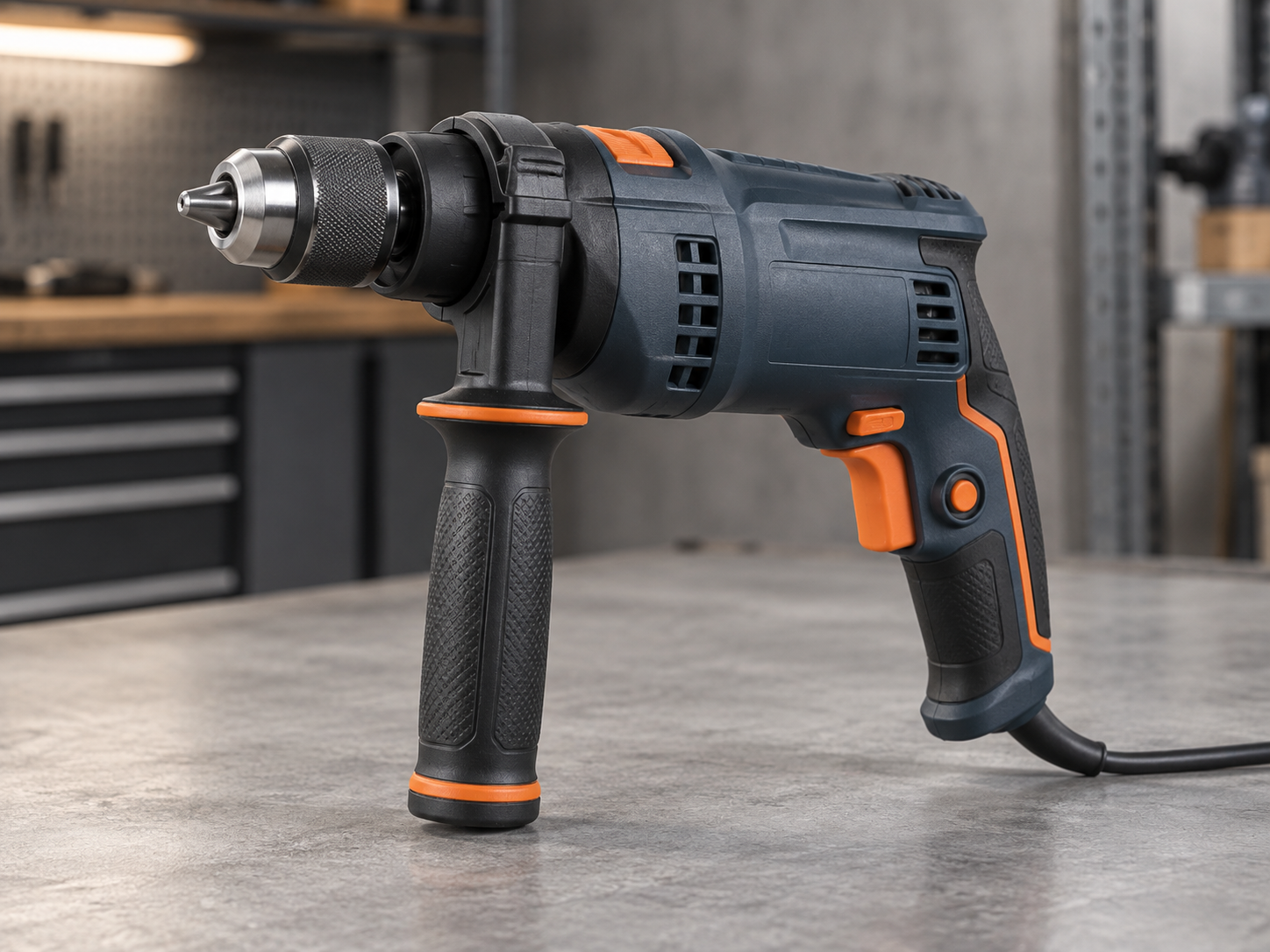
Caption: The quoted kit should identify the drill, battery, charger and every supplied accessory.
Understand capacity and energy without overpromising runtime
Battery capacity is commonly expressed in ampere-hours, while transport and some documentation use watt-hours. The arithmetic relationship is voltage multiplied by ampere-hours, but the resulting number is an energy rating, not a guarantee of how many holes a user can drill. Runtime changes with bit, material, load, temperature, state of charge, battery condition and operating pattern.
Ask the supplier to identify the battery model, chemistry, nominal voltage, capacity marking and compatible charger. If a marketing claim states a number of holes or hours, request the test method. A buyer can conduct an application-led sample review with representative work and report its observations with conditions; it should not convert one test into a universal promise.
Also consider the practical weight and balance of the selected battery. A higher-capacity pack may be attractive on a feature sheet but can change the tool’s handling. An installer working overhead may value a different compromise from a workshop user. Sample the body with the actual pack intended for the retail kit.
Specify the charger as a product, not an afterthought
The charger has its own input supply, plug, battery interface, labels, instructions and packaging. Confirm the destination market and power connection before sample approval. A kit with a correctly specified drill but the wrong charger plug is not ready for sale. Ask whether the proposed charger is supplied in every carton and how its identity will be checked during packing.
Charging time claims also need conditions: battery model, initial state of charge, ambient conditions and charger configuration. If a buyer includes a rapid charger, the label and manual should make the compatible batteries clear. If the package includes no charger, the product listing should say so prominently and identify the compatible system.
The supplier should explain how it handles a charger or battery revision. A change of cells, charger electronics, housing or connector may affect performance, compatibility, documentation and transport planning. The approved sample is a specific system, not merely a colour scheme and voltage label.
Plan the complete retail and service package
Write a bill of contents that a warehouse team can check: drill body, battery quantity and model, charger, case or carton insert, bit or driver accessory, manual and any market-specific labels. If some items are optional, distinguish SKUs clearly. A “tool only” offer and a “kit” offer should not share an ambiguous product name or photograph.
For a private-label programme, keep model and battery identification traceable. A customer asking for an additional pack or replacement charger needs a reliable compatibility answer. A distributor who cannot identify the battery variant from the box may face preventable returns or unsafe substitutions. Service information belongs in the launch plan, not in a later emergency response.
The ToolViron product pages show currently published categories. For a proposed cordless project, send the desired kit specification and target market rather than assuming a particular platform exists. A supplier can then discuss feasibility and sample steps honestly.
Test the kit under a representative work pattern
Sample approval should use the exact battery and charger intended for sale. Record drill mode, bit or fastener, material, number of repetitions and observations. Include charge and recharge preparation in the review: can a new user connect the pack, read charge information if present, and understand charger indicators? This is installation preparation from the customer’s perspective.
Test handling at different stages of the task. The weight distribution may feel different when changing from drilling to overhead fastening. Observe tool control, pack retention and access to controls. If the buyer expects one pack to serve several tools, test the stated compatibility with each approved model rather than assuming the interface works across the whole range.
Document limitations. A single battery may be sufficient for occasional tasks and inadequate for continuous field work. A second pack may increase cost and shipping complexity. The correct kit is the one that serves the customer and channel with a clear price and support plan.
Mid-article sourcing CTA: Planning a cordless drill offer? Send your intended tasks, battery quantity, charger input and market for a complete kit discussion.
Prepare battery shipment information early
For a separate checklist covering pack configuration, documents and carrier review, see the lithium-battery power-tool shipping guide.
Lithium-ion batteries affect transport classification and documentation. The 2026 IATA battery guidance distinguishes batteries shipped on their own, packed with equipment and contained in equipment. Requirements vary by transport mode, configuration and carrier. Buyers should coordinate with a qualified logistics partner rather than assuming that a charger or tool carton can move by any route.
The FAA’s shipping guide emphasizes the shipper’s responsibility for classification, packaging, marks and labels before offering goods to an air carrier. Confirm the battery identification, watt-hour data, relevant test summary and packing arrangement early enough to influence the order. This is a planning point, not a blanket statement that one marking or document covers all shipments.
Ask the supplier how batteries will be protected from accidental activation and short circuit in the agreed pack. A change from a tool-only SKU to a kit with battery can alter the transport discussion. Keep logistics, product and packaging teams working from the same bill of contents.
Connect factory testing and shipment inspection
The factory testing plan should include checks relevant to the configured system: drill function, pack fit and retention, charger identification, visible condition, labels and included items. Ask the supplier which checks are applied to the sample, during assembly and before packing. Do not accept a generic “QC passed” statement as the only explanation.
Shipment inspection should compare the finished kits to the approved sample and packing record. Count batteries and chargers by model, confirm destination plug and manuals, verify carton identity and review the agreed battery shipment information with the logistics team. A third-party inspector needs the final bill of contents and product variant list, not just a photo of the drill.

Caption: A sample and shipment check should cover the complete cordless system.
If a finding arises, identify whether the issue affects product function, compatibility, market information or transport packing. Each has a different owner and corrective action. Resolve it before release and update the controlled configuration for the next order.
Make the product listing easy to verify
The customer should be able to answer five questions quickly: What tasks is the drill designed for? How many batteries are included? Which charger and plug are included? Does the battery work with another product in the range? What accessories and case are in the box? If the answer to one of these changes by SKU, use separate images and product information.
After launch, record customer questions by kit variant. If buyers repeatedly ask whether a charger is included, the listing may be unclear. If spare battery demand is high, the distributor may need a separate accessory SKU. Such feedback improves a range without inventing performance claims.
Compare platform value across several tools
If a distributor sells a drill alongside a grinder or saw on one battery platform, shared packs can simplify the customer’s purchase. But a platform claim must be verified for every tool, battery and charger combination. The same physical rail does not prove the pack is approved for the load or that the charger supports the exact battery revision. Maintain a current compatibility chart with model identifiers and dates.
Ask how the range will grow. A one-tool launch can work with a dedicated pack, but later adding tools may expose a proprietary connector that buyers cannot support. Conversely, building a platform only for marketing may add complexity if the retailer does not intend to stock spare packs or service them. The purchasing choice should align with a realistic three-year assortment plan, not just an attractive cross-sell diagram.
The customer’s total kit cost is also important. A tool-only drill can be a good second purchase for an established platform user, but it is not a complete offer for a new customer. Place the tool-only and kit versions in separate SKUs with clear images. Sales staff should be able to explain what additional items are needed to make the tool usable.
Plan battery end-of-life and returns
Battery packs are not ordinary mixed waste. Importers should check the collection, recycling and producer-responsibility requirements of each destination market and establish a process with qualified local partners. Do not invent a universal disposal instruction for a global product page. The model manual and market-specific information should guide users to appropriate facilities.
Prepare a way to handle damaged or suspect batteries separately from ordinary warranty returns. Support staff need to know when to stop use, how to request photographs safely, and when to refer the case to a trained logistics or service specialist. A cracked pack or overheating report should not trigger a casual “mail it back” instruction. Carrier rules can differ for damaged or defective batteries.
Track pack-related complaints by battery model and batch. A high number of charging questions may reveal unclear indicators, a plug mismatch or a manual issue rather than a cell failure. Use the evidence to update instructions and supplier checks. This is more useful than claiming a battery life that has not been measured over a defined cycle test.
Questions to resolve at final kit approval
Does the quoted carton contain the same battery and charger tested with the drill? Are voltage, capacity, plug and compatibility claims consistent across the tool label, pack label, manual and online listing? Is a spare battery shown in photos but not included? Can the retailer order the approved pack six months later? Has the shipping configuration been reviewed for the exact pack count and route?
These questions should be answered on a single kit sign-off sheet with model identifiers and photos. A cordless range is especially vulnerable to variant confusion because tool-only, one-pack and two-pack offers can look nearly identical online. Separate their SKUs and box-contents images. The customer should never have to infer whether a charger is included from a small icon.
If a battery or charger changes before production, rerun the relevant compatibility and logistics checks. A pack that fits the rail is not automatically approved, and a new charger plug can affect market suitability. Treat changes as controlled revisions, not substitutions hidden inside an unchanged product name.
Frequently asked questions
Does a higher ampere-hour battery always give more useful runtime?
It stores more rated energy within a given platform, but actual runtime depends on load, tool, temperature and usage. It can also change weight and handling. Evaluate the exact pack in representative work.
Should the battery and charger be included in every cordless drill kit?
That depends on channel and customer. A first-time buyer usually needs a complete system; an existing platform user may prefer a tool-only SKU. The listing and carton must identify the contents clearly.
What battery information should an importer request?
Request the exact battery identity, voltage, capacity or watt-hour marking, compatible charger, relevant test summary and the proposed transport configuration. Confirm applicable shipping rules with qualified logistics providers.
Can two batteries with the same voltage be treated as interchangeable?
No. Compatibility depends on the approved mechanical and electrical interface, charger and tool platform. Verify it for the exact models and do not promise it based on voltage alone.
Conclusion
A cordless drill kit should be specified and approved as a complete system. Define the customer’s work, select the pack and charger, confirm compatibility and box contents, test the configured sample, and prepare transport information before shipment planning becomes urgent.
Send your requirements
Tell ToolViron your intended drill application, market, battery and charger expectations, kit contents and estimated order quantity. Send your requirements to start a product feasibility and sample discussion.
Images illustrate product and inspection topics; they are not documentary evidence of a specific ToolViron test or customer project. Confirm the exact model and market requirements before ordering.