
A grinding accessory can match an angle grinder's advertised diameter and maximum speed yet still be wrong for its mounting system. The wheel bore, spindle, inner flange, outer flange or hub, guard and tightening method must form a compatible assembly. Importers who approve the tool body and accessory bundle in separate spreadsheets can miss that interface until retail kits reach customers. An approval check must bring the actual pieces together, following their instructions and applicable safety requirements.
This guide is a purchasing and inspection framework, not a universal mounting procedure. Flange geometry and wheel types vary. Do not use a washer, adapter or reversed nut simply because it appears to make a disc fit. Obtain the exact grinder and abrasive manufacturers' instructions and have a competent person review the assembly before any powered test.
Identify the complete mounting stack
Ask the supplier to lay out the grinder spindle, inner flange, intended accessory, outer flange or retaining nut and supplied wrench in the order specified for that configuration. Photograph each piece and record its item number. If a disc has a built-in hub, its installation may differ from an unthreaded wheel. A price quote for “one disc” should therefore include its mounting style, bore and the matching parts supplied in the box.
Read the grinder's rating and the accessory label together. Nominal diameter, thickness or form, maximum speed, bore and intended operation all matter. The grinder wheel speed checklist covers the rating side; the cutting-versus-grinding guide helps identify the operation. This article deals with the physical interface and whether a user can mount the approved wheel as intended.
An importer should record local replacement availability. A grinder that accepts only a hard-to-source accessory may work in a sample room but disappoint customers after the starter disc is consumed. Check the exact spindle or arbor specification and the wheel format sold in the destination market. Do not assume a visual match or common industry shorthand is enough; variant data belongs in the product file.
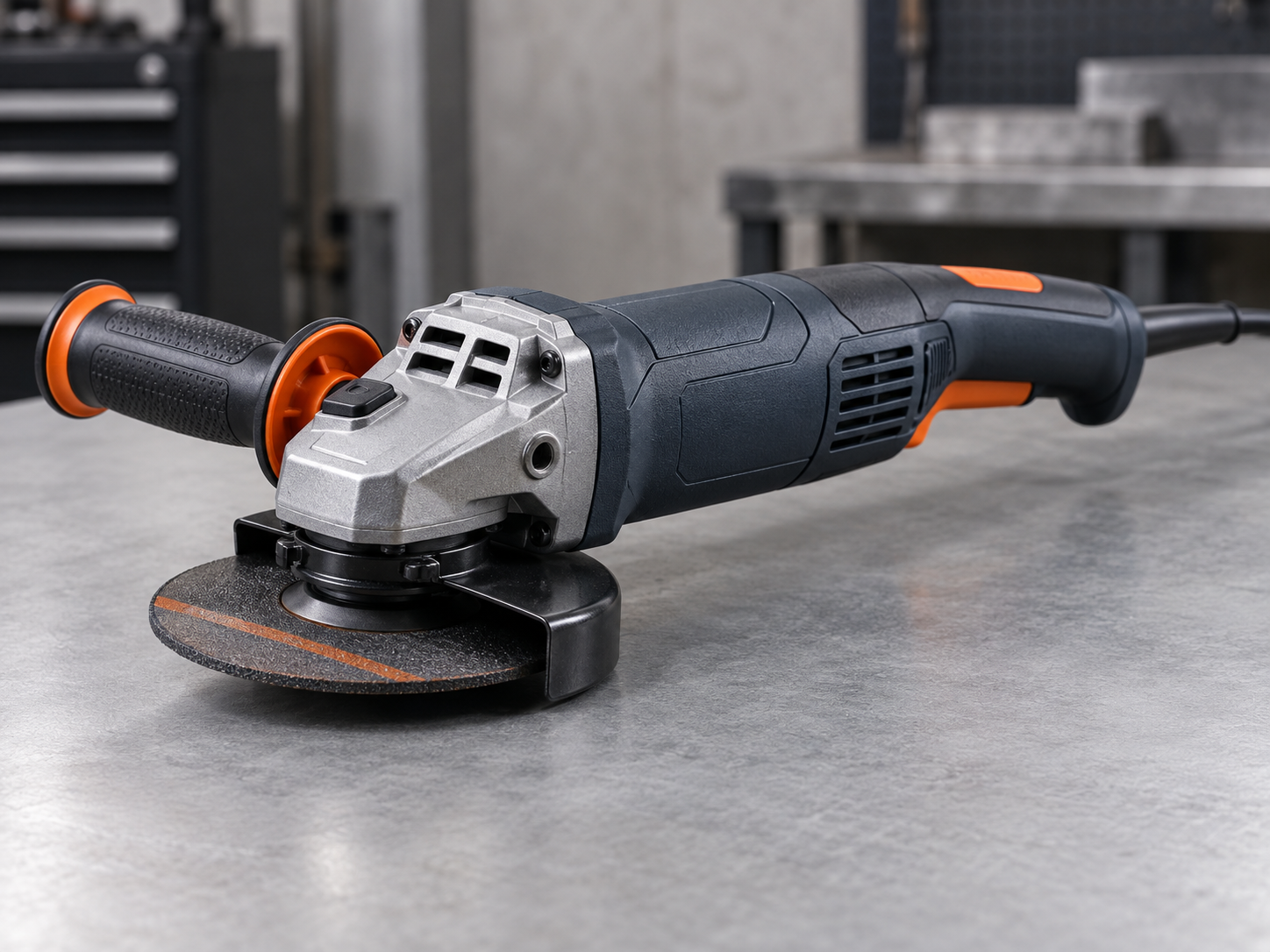
Caption: The spindle, flange, wheel and guard should be approved as one compatible system.
Inspect the tool and accessory without power
Disconnect the tool or remove its battery before handling the mounting assembly. A trained reviewer should check the spindle threads, seating faces, flange orientation, wheel bore condition and guard position using the manufacturer's method. Look for shipping damage, burrs, missing parts or a retaining nut that does not seat correctly. Do not force a wheel onto the spindle or modify the bore. A wheel that rocks, binds or touches the guard is not ready for a powered sample test.
The mounting method can change by abrasive construction. OSHA's abrasive-wheel machinery standard discusses flange design and inspection for the equipment and wheel types it covers. An importer should not copy one clause onto a different grinder without checking scope. The actionable lesson is to treat the correct flange and wheel combination as an engineered interface, not a minor accessory detail.
Check that the guard and side handle can be installed in the intended positions while the selected wheel has adequate clearance. If a particular accessory needs a specific guard, identify that guard in the kit. Do not remove or trim a guard to clear a disc. A product photograph with the guard absent for aesthetic reasons can also create a poor user example; use the actual configured assembly in technical photography.
Test with the real accessories and instructions
After the static inspection, a qualified team can carry out the manufacturer's prescribed run and representative application test under controlled conditions. The purpose is to observe seating, free rotation, vibration, guard clearance and whether the accessory performs the specified job. Do not continue using a disc that runs untrue, vibrates abnormally or shows damage. The OSHA portable-tool publication stresses inspection and correct mounting before use.
Record the exact disc lot and model used in the approval test. A sample could pass with one manufacturer's hubbed flap disc while the production kit later switches to a non-hubbed accessory that needs a different flange arrangement. A change in wheel construction may require re-approval even if the advertised diameter stays unchanged. The bill of materials should therefore identify the accessory sufficiently to prevent silent substitution.
If the tool is intended to support several accessory categories, test each proposed category with its approved hardware. Do not extrapolate a successful grinding-wheel trial to a cutting wheel, wire brush or cup accessory. Each has its own intended use and may call for different guarding or mounting requirements. A broad “multi-purpose grinder” claim needs a carefully delimited compatibility list.
Mid-article sourcing CTA: Approving a grinder kit? Send the tool model, spindle information and intended abrasive list so the mounting and sample questions can be resolved together.
Make the retail kit understandable to the user
The manual should show the exact supplied flange arrangement and describe how to install only compatible accessories, following the product-specific requirements. Include a clear parts illustration and identify any orientation-dependent component. A customer should not be left to infer which side of a reversible retaining nut faces the wheel from a generic image. If multiple regional versions exist, make sure each insert corresponds to the actual packed version.
The box-content list should state whether a wrench, inner flange, retaining nut, guard and side handle are supplied. A missing low-cost part can make the entire product unusable on first opening. If an accessory requires a component not supplied, disclose that before purchase and confirm a local purchase route. This is especially important for e-commerce, where a customer cannot ask a counter salesperson to inspect the package.
Label replacement discs by their compatibility attributes, not just by “fits our grinder.” The latter may become false when a model is revised. A distributor can maintain a simple table containing grinder SKU/revision, permitted accessory SKU, mount, guard and instructions. This also supports customer service: when a user reports a disc that will not seat, the team can ask for both item numbers instead of troubleshooting blind.
Connect incoming checks, assembly and shipment inspection
At incoming inspection, the factory can verify that supplied flanges, guards and nuts match the approved parts specification. At assembly or kit packing, confirm the right components are placed with the right grinder variant. A sample powered check cannot compensate for mixed accessory bins. Keep separate part identifiers if two markets use different spindle arrangements or accessory packs.
The shipment inspector should open sampled retail cartons and compare the actual wheel, guard, flange and wrench with the signed-off bill of materials and manual illustrations. Note any missing or substitute parts. Check that the accessory label is legible and that packaging protects the abrasive from damage. A final inspection is strongest when the approval record includes photographs of the correctly assembled sample and individual components.
If customers later report fit problems, preserve the returned wheel and grinder identifiers. Investigate whether the issue stems from incorrect parts in the kit, an unapproved retail replacement disc, damaged threads or unclear instructions. Record the corrective action by batch. This is more informative than counting every complaint as “bad grinder.” The spare-parts service guide can help organise the follow-up.
Avoid misleading compatibility shortcuts
A wheel's bore diameter should not be treated as the entire mounting specification. Shape, flange support, hub design, wheel thickness and guard clearance matter. Nor does the fact that an accessory can be physically tightened prove it is authorized. When a category manager sees a new low-cost disc quote, the right question is whether the entire mount and operating configuration remains compliant and effective.
The exact electric-tool safety framework and market requirements must be checked for the final product. IEC 62841-1 gives general scope, but product-specific standards and accessory instructions govern many details. This article is not a conformity declaration or a substitute for engineering approval.
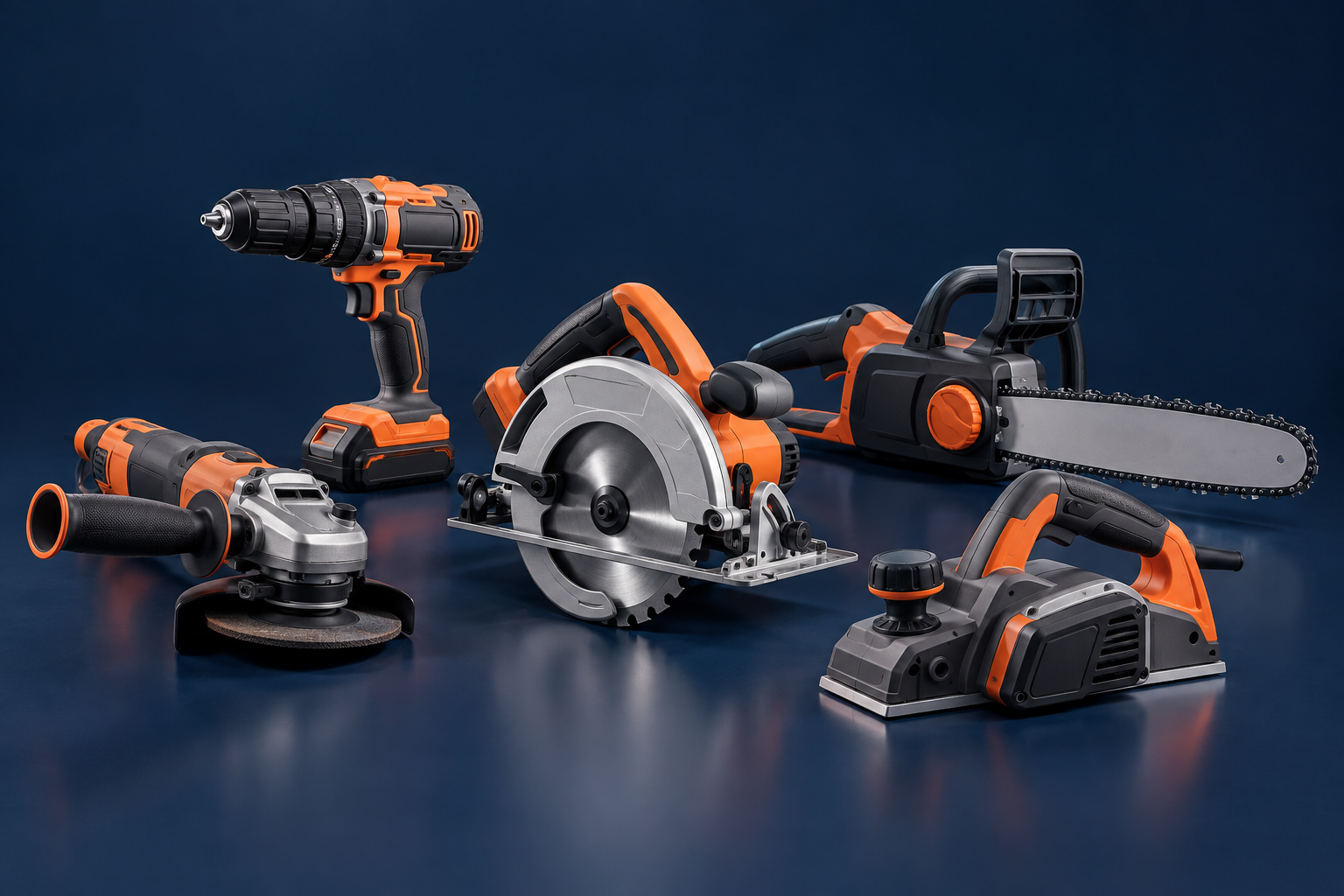
Caption: Illustrative range photography: accessory and safety details require model-specific review.
A compatibility matrix for a distributor range
Imagine a distributor with a compact grinder, a larger grinder and three abrasive accessory families. Rather than a catalogue note saying “fits our grinders,” build a matrix with one row for each exact tool revision and one column for each accessory SKU. Each cell should state approved or not approved, the required guard, flange or hub, the permitted operation, and the manual reference. This is more work than copying a diameter label, but it prevents the retail and service team from guessing at the mounting interface.
Test the matrix physically. A qualified technician should assemble each proposed approved combination with the power source isolated, inspect clearance and seating, and then perform the manufacturer's prescribed functional check in a safe setting. If an accessory is not approved, record the reason: speed rating, bore, guard, flange support, interference or lack of evidence. The matrix should not treat “not tested” as “approved.” An importer can choose to narrow the range to combinations that can be supported confidently.
The support desk can use the same matrix. A customer who reports that a wheel wobbles should be asked for both the grinder and accessory identifiers, not told to tighten harder. A buyer who says the new disc “looks the same as last year's” should be directed to the revision and lot information. This approach protects customers and gives the importer a way to identify whether the issue is a wrong purchase, packing error, component revision or damaged part.
Include regional variants. A grinder model sold in two markets may use different accessory packages or instructions even when its body looks similar. The matrix should identify the destination market and the exact retail SKU. If a supplier proposes a cheaper replacement wheel, add it as a new candidate and perform the same review rather than overwriting the old cell. Preserve the test result that supported the prior package.
A receiving and packing checklist
At incoming inspection, verify flange and guard part numbers, wheel labels and visible condition against the approved documents. At line packing, segregate parts by grinder variant; do not rely only on visual similarity between nuts or guards. A sample pack should be assembled in front of the inspector so missing hardware is discovered before cartons are sealed. The check should include the wrench and any instruction insert that explains the specific mounting arrangement.
If an accessory is packed separately from the tool, ensure it cannot be bent or abraded in transit. A damaged wheel should not be approved simply because its markings are correct. The product's intended replacement route should be listed in the manual or customer-support data so users do not try an unknown adapter after the starter wheel is used. Packaging, service and safety are linked through this seemingly small interface.
Finally, specify the action for a failed fit check. Quarantine the affected accessory lot, compare supplier certificates and physical dimensions where appropriate, investigate whether the flange or wheel changed, and document rework or rejection. A shipment inspector cannot repair a mismatched system by adding an improvised washer. The original approved assembly should remain the reference until a qualified change is accepted.
A final red-flag review
Reject a proposed accessory package if the supplier cannot identify the exact flange or retaining nut supplied with the grinder, if the wheel label is unreadable, or if the sales image shows an assembly not permitted by the manual. The buyer should also question claims that one unverified adapter makes every market's disc fit. An accessory that mounts only after improvised spacing, guard removal or excessive tightening is not a valid candidate. Record the failed combination and reason so another team member does not repeat the same mistake on the next order. A narrower compatibility list supported by real tests is more valuable than a long, speculative catalogue.
Frequently asked questions
If the wheel diameter matches, will it fit the grinder?
Not necessarily. Bore, hub, flanges, spindle, guard, thickness and rating must also be compatible. Compare exact models and instructions.
Can a washer be added to make a loose wheel fit?
Do not improvise spacers or adapters. Use only the mounting arrangement approved by the grinder and accessory manufacturers for that configuration.
Should the flanges be part of the sample approval?
Yes. Photograph and identify them with the tool and selected accessory. A changed flange or retaining nut can change fit even when the tool's exterior is unchanged.
What should an inspector check in a packed kit?
Check the grinder SKU, supplied guard, handle, flange, nut, wrench, accessory identity, labels and matching manual. Compare them with the approved bill of materials and sample, not a generic catalogue image.
Conclusion
Approve the grinder and abrasive as a complete mounting system. Inspect the physical interface without power, verify the exact accessory in a controlled test, and carry the parts list into packaging and shipment inspection. A small hardware mismatch can undermine a technically sound grinder, so it deserves the same change control as the motor or switch.
Send your requirements
Share the intended grinder configuration, wheel types, market and kit contents. ToolViron can discuss the interface questions that should be settled before sampling. Send your requirements to start.
Images illustrate product and inspection topics; they are not documentary evidence of a specific ToolViron test or customer project. Confirm the exact model and market requirements before ordering.