
A cutting disc and a grinding wheel may both fit an angle grinder, but they are designed for different work. A cut-off wheel works through its edge to separate material; a grinding wheel is designed for material removal with the intended grinding surface and mounting arrangement. A B2B buyer should not treat the two as interchangeable accessories simply because their diameter matches the tool.
The purchasing decision includes disc type, diameter, arbor, rated speed, guard, flange, work material, carton description and user instructions. If a supplier quotes a grinder with “two discs included,” ask exactly which discs, for which applications and with which guard. That detail prevents a kit from promising work it is not configured to support.
Define the job the kit is meant to solve
Start with the customer’s task: cutting a metal section, removing a weld, preparing a surface or finishing an edge. The work determines the accessory and guard direction. A customer buying a grinder for metal cutting may value a cut-off wheel in the kit; a fabrication shop doing weld clean-up may need a grinding wheel or flap disc instead. A broad “cutting and grinding” phrase can be appropriate only if the supplied configuration supports both tasks.
Specify the material and working pattern. A thin metal panel differs from a heavy steel section. Occasional home repair differs from daily fabrication. The buyer does not need a dramatic laboratory demonstration; it needs a sample review that resembles the intended product application and records the accessory used.
3M’s cut-off wheel information distinguishes edge cutting from grinding and warns against using cut-off wheels for grinding. That source concerns 3M products, but the general purchasing lesson is clear: follow the wheel maker’s intended use and match the tool, guard and mounting system. Do not transfer a brand-specific performance claim to an unrelated private-label accessory.
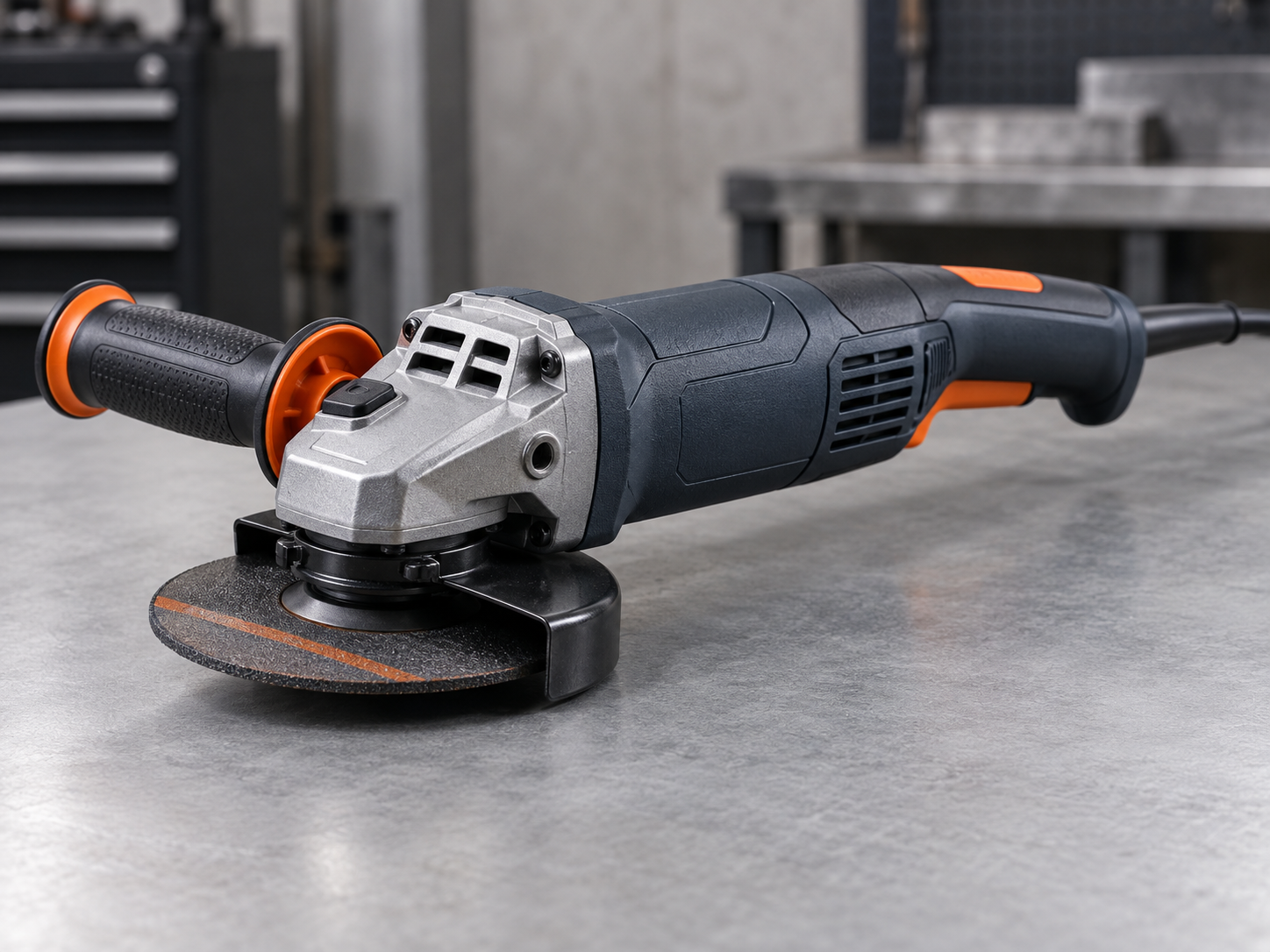
Caption: The wheel type and guard belong in the same approved grinder configuration.
Inspect the accessory marking
The wheel should have identifiable information for its type, size and maximum permitted operating speed, along with the markings and instructions applicable to its market. A buyer comparing supplier samples should photograph and record these markings. A carton that says “cutting disc” while the packed wheel is another type creates a traceability and customer-information problem.
Diameter alone is insufficient. Check thickness, arbor or bore fit, wheel construction, flange requirements and any guard compatibility stated by the wheel manufacturer. If the accessory bundle changes, recheck the system rather than assuming the new wheel is a like-for-like substitution. The ToolViron grinder product page can be used as the starting point for a model-specific sourcing discussion.
Do not use a cutting wheel for side grinding unless the wheel is specifically designed and labelled for that application. Thin cut-off wheels are not a shortcut to a lower-cost grinding bundle. A procurement team should make this rule visible to product managers and marketing staff so imagery does not depict an unsuitable operation.
Confirm speed compatibility
The related wheel-RPM compatibility guide provides a model-level checking framework for buyers assembling a grinder-and-accessory kit.
The maximum operating speed stated for the wheel must be compatible with the grinder’s maximum spindle speed. OSHA’s abrasive wheel guidance addresses guards and safe use in U.S. construction settings; 3M also states that its cut-off wheel’s maximum operating speed must be at least the tool’s maximum. Buyers should apply the exact manufacturer instructions and local requirements for the final product.
Never compare a wheel’s rated RPM with an unspecified “working speed” from a catalog if the grinder can run faster. Record the actual product model and rating. If an angle grinder has a variable-speed setting, that does not automatically justify fitting a lower-rated wheel; the user may later select a higher speed. The safe and market-appropriate configuration needs a clear review by competent people.
The buyer should ensure the wheel information remains legible after packing and through distribution. If a consumable is sold separately, the accessory page should identify compatible tool range and limitations without inventing universal compatibility.
Review the guard and mounting arrangement
A guard is part of the approved tool configuration. Ask the supplier which guard is supplied for the intended disc and task, how it is adjusted, and whether the instruction material shows the correct position. OSHA guidance for portable abrasive wheels emphasizes guard alignment and strength. The exact legal obligations vary by market; the buyer should confirm its route locally.
Also review flanges, spindle, wrench or tool-free mounting parts, and whether each wheel can be installed according to its maker’s instructions. A wheel that fits over a spindle but requires another flange system is not ready for inclusion in a kit. This is a practical sample-approval check, not a packaging formality.
Use photographs of the final guarded configuration in the product listing. If marketing images show an exposed wheel or a missing side handle while the manual instructs otherwise, the buyer should correct them before release. Images are part of the user’s first setup expectations.
Mid-article sourcing CTA: Building a cutting or grinding offer? Send the material, wheel type, guard and target market for a configuration review.
Design a sensible retail bundle
A retail bundle should help the first customer task. It may include one clearly specified cut-off wheel, a grinding wheel, a handle, a wrench and a manual, but only if the tool and guard arrangement support those items. The right contents depend on channel, price position and destination market. An experienced fabricator may prefer a bare grinder and specialised consumables, while a home-maintenance buyer may value a small labelled starter set.
Distinguish “included” from “compatible.” A product page should list actual box contents and separately recommend suitable accessories. Avoid showing a group of discs in an image if only one is supplied. This can lead to complaints even when the grinder itself works well.
For a private-label assortment, use consistent names and accessory identifiers. The replacement disc should be easy to reorder without guessing from its colour. A supplier can prepare a part list, but the buyer should confirm the range it intends to stock after launch.
Test the configured sample
Create a sample review with the intended material, secured workpiece, correct protection and each proposed disc. Follow the tool and wheel maker instructions. Record mounting fit, guard position, handling, visible finish and whether the selected accessory matches the claimed task. The aim is to approve the product system, not compare dramatic cutting speed under uncontrolled conditions.
Check the setup sequence. Can the user identify which wheel is for which job? Are instructions readable? Does the spanner or mounting method work with the included parts? A kit can pass a powered function test and still fail customer preparation if the instructions or accessory identity are unclear.
If a wheel substitution is proposed after approval, document the reason and rerun the relevant compatibility and packing checks. A disc is a consumable, but it is not an interchangeable commodity for procurement purposes.
Align factory and shipment inspection
Factory testing of the grinder should confirm the relevant configured functions and controls. Packing inspection should then confirm the guard, handle, accessory types, markings, manual and carton contents. Ask for the acceptance criteria and how nonconforming accessories are separated. A generic “100% tested” claim does not answer which wheel was placed in a particular box.
Shipment inspection should compare packed units with the approved configuration record. Include the product model, wheel identity, guard, mounting parts, labels, manual and quantity. A third-party inspector needs the approved wheel and carton references. See the ToolViron quality overview for a starting framework for the discussion.

Caption: Final packing checks should verify the wheel type and every mounting component in the approved kit.
If a mismatch appears, do not solve it only by rewriting the listing after shipment. Determine which physical goods were packed, what the instruction says and what corrective action is needed before dispatch.
Learn from field questions
Customer questions about wheel replacement, guard position and cutting versus grinding can reveal unclear labeling. Keep a simple support log by model and accessory. If the majority of users cannot tell which wheel to select, the kit needs better identification even if no tool defect exists.
A buyer should also watch for accessory inventory gaps. Selling a starter wheel without a compatible replacement route can make the grinder less useful after the first job. Product support is part of the range design.
Handle wheel changes in the commercial specification
If a distributor wants to switch accessory suppliers after the first order, treat the new wheel as a new approved component. Compare its marking, rated speed, bore, thickness, intended material and mounting instructions with the original. A lower price does not establish equivalent performance or compatibility. Retain a sample of both versions and document which production batch contains each one.
The kit manual and artwork may need revision after a wheel change. A photograph of a thick grinding wheel should not appear on a carton that now includes only a thin cutting disc. Likewise, the customer service team needs the correct replacement part number for each batch. Versioning these details may feel administrative, but it prevents a buyer from trying to use a replacement accessory based on a description that belongs to another kit.
Ask whether the new wheel has product-specific test evidence and destination-market information. Do not accept a generic certificate that names a different manufacturer, size or product family. The importer remains responsible for making appropriate checks for the market in which the item is sold.
Use customer questions to sharpen the bundle
After launch, group customer questions by application. If many ask whether the supplied disc can grind a weld, the kit description may be unclear. If users regularly need a different guard or flange, the bundle may have been specified incompletely. Investigate the actual configuration before revising a product page or adding another accessory.
Retailers can explain the difference in a simple comparison card: cutting through material with the edge versus removing material with an accessory designed for grinding. The card should include a reminder to follow the exact wheel and tool instructions. It should not include a broad “any metal” claim without considering wheel specification and workpiece.
For an export buyer, make this card translatable. Technical terms for cutting, grinding and finishing should be consistent across the package, manual and web listing. Conflicting translations are a real source of setup errors, especially when several similar discs are bundled together.
A sample-approval worksheet for a mixed-use kit
Prepare one row for cutting and a second for grinding. In each row, record the exact wheel SKU, manufacturer, permitted operation, size, bore, thickness, maximum operating speed, material, required guard and mounting components. Add the grinder model and nameplate data at the top. This structure makes missing information visible: if the grinding row has no approved guard or wheel label, the kit is not ready to be sold for grinding.
Then add an application note. For cutting, specify a representative workpiece and whether the customer makes a straight section cut or a more specialised operation. For grinding, specify the surface and amount of material removal. Record whether the operator has a usable grip and line of sight with the correct guard fitted. The aim is to check a coherent product application, not to show the longest possible spark trail in a video.
The worksheet should also identify what the customer receives versus what the factory used in its demonstration. If the demonstration used a premium disc while the retail kit contains a lower-cost accessory, the result is not directly representative. Either test the packed disc or label the premium item as an optional accessory. Keep samples of both when needed.
Before approving artwork, compare the worksheet with every photo and icon. A photo of side grinding with a thin cut-off wheel is not acceptable just because the grinder can physically hold it. A picture can communicate misuse more forcefully than a warning buried several pages into a manual.
Handling a real customer complaint
Suppose a retailer reports that a disc shattered during use. The importer should not immediately assume misuse or product defect. Secure the tool and accessory information, batch number, photos, work material, guard configuration and customer account of the event. Escalate under the company's safety incident process and avoid asking a customer to repeat the task. Qualified technical and regulatory staff can determine what evidence is needed.
Another complaint may be that the wheel “does not grind well.” First confirm that it is actually a grinding accessory designed for the material. A cutting wheel misapplied to side grinding is not a performance comparison; it is a safety concern. If the correct wheel is present, investigate the work material, wheel condition and tool configuration. Repeated reports tied to one accessory batch may justify a supplier review.
This distinction between safety incident, compatibility question and ordinary performance feedback should be built into retailer training. It helps the buyer respond responsibly and gives the factory usable information for improvement.
Frequently asked questions
Can a cut-off wheel be used for grinding?
Follow the wheel maker’s instructions. A standard cut-off wheel is intended for edge cutting and should not be used for side grinding unless specifically designed and marked for that use.
Is disc diameter enough to prove compatibility?
No. Check rated speed, thickness, arbor or bore, flange, guard, wheel type and the instructions for the exact grinder and accessory.
What should a buyer ask for in a grinder quotation?
Ask for tool model and rating, wheel type and identity, guard and handle, mounting parts, supplied quantity, labels, manual, carton and inspection plan.
Should a distributor include both wheel types?
Only if its customer tasks and the approved tool configuration justify the bundle. A clearly described single-purpose kit can be better than a confusing multi-disc package.
Conclusion
Cutting and grinding are distinct applications. Define the customer’s work, select a wheel intended for that work, verify speed and mounting compatibility, and approve the guard and package together. The resulting kit is easier to sell, inspect and support.
Send your requirements
Tell ToolViron the intended material, wheel types, target user, market and order plan. Send your grinder requirements to discuss a configured product and sample review.
Images illustrate product and inspection topics; they are not documentary evidence of a specific ToolViron test or customer project. Confirm the exact model and market requirements before ordering.