
The choice between a 12V-class and an 18V-class cordless drill is a platform decision, not a contest that the larger number automatically wins. A compact tool may be easier to handle in cabinets, service spaces and repeated overhead work. A larger platform may provide a broader assortment of batteries and higher-demand tools. Neither conclusion can be made from nominal voltage alone: the exact motor, battery, gearing, chuck, control electronics and intended application determine the user experience.
Importers should therefore decide what customer problem the platform solves before asking for a quotation. A first-order retailer may need one straightforward compact kit. A trade distributor may want a platform that supports several tools, spare packs and service parts. These are different business models. This guide shows how to compare them without inventing an equivalence between unlike samples or promising a fixed runtime in every job.
Define the target work before comparing voltage classes
Start with the actual jobs: furniture assembly, cabinet installation, general maintenance, steel drilling, site carpentry or repeated larger holes. Record common bit diameters, fastener types, material, work duration, access constraints and the percentage of work that occurs away from mains power. The more the work depends on portability and cramped access, the more grip, tool length and total kit weight matter. The more it depends on a wider set of heavier-duty cordless tools, the more the battery ecosystem matters.
A compact 12V-class kit can be attractive to an installer who works repeatedly inside finished rooms, carries the tool up ladders and values a smaller battery at the handle. Yet it would be misleading to claim every 12V tool is lighter than every 18V tool. Pack sizes and designs vary. Likewise, an 18V-class drill is not necessarily too large for installation work; some models are compact. Compare real configured samples, each with the pack that will ship.
Ask how many tools the customer expects to add within two years. If the programme starts with a drill but will later include grinders, saws or lights, the battery platform may be a range-level commitment. Check whether each proposed tool actually accepts the same battery and charger. A voltage label is not a compatibility guarantee across manufacturers, product families or revisions.
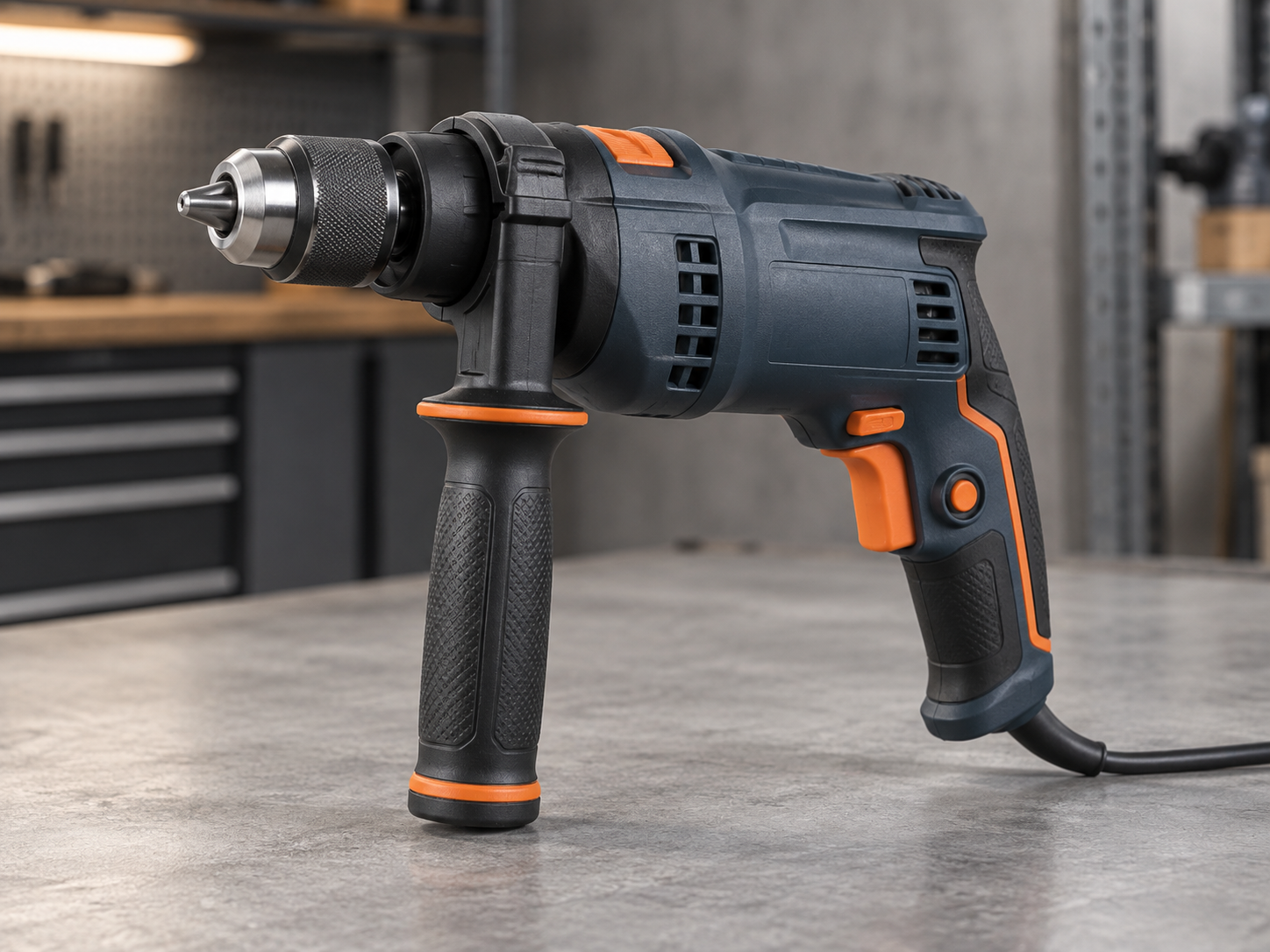
Caption: Voltage class belongs in a complete application and battery-platform brief.
Compare the whole kit, not the bare drill
List the drill body, each battery's stated capacity and identification, charger input and plug, chuck, case, bits, manual, labels and replacement route. A bare-tool price compared with a two-battery kit price is not a valid platform comparison. Nor is a compact pack compared with a high-capacity pack when the category buyer expects the products to sit at the same price point. Build two configurations with clearly stated contents before requesting landed-cost estimates.
The battery matters to handling as well as energy. A pack at the base changes the centre of gravity and can affect how a drill sits on a work surface. A small pack may improve access but require more frequent changes for some work; a larger pack may extend usable time under certain conditions but increase weight. Sample with the chosen production-intent pack, not whatever battery is convenient in the test room. If several pack options are proposed, treat them as separate retail SKUs or document the precise variant sold in each channel.
The charger is equally important. Verify rated input, plug, power cord, supported battery IDs, indication sequence, charging environment and whether the proposed market can source replacements. Do not promise a charge time without defining starting state, pack capacity, temperature and test method. The cordless drill kit specification guide lays out the item-level decisions that belong in the approval record.
Make performance claims comparable
Nominal voltage is a descriptor of a battery platform, not an application result. Rated speed, torque and claimed drilling capacity also need context. A stated no-load RPM is not the same as speed under load; a maximum torque number may be measured in a way that does not predict fine screw control. Use the same bit type, similar bit condition, defined material and task when comparing two drills. Record the settings, battery state and operator.
For a cabinet installer, compare a set of repeated pilot holes and controlled fasteners in representative board material. For a maintenance buyer, include metal drilling with the correct bit and lubricant where recommended. For a general hardware retailer, a smaller mixed-task panel may be more realistic than a single extreme load. The torque and RPM guide explains why one headline specification should not drive the decision.
If the programme intends to publish runtime or holes-per-charge language, treat that as a separate controlled test. Record pack ID, capacity, state of charge, ambient conditions, tool mode, material, bit, hole size, rest intervals and stop rule. A best-case result from one new pack is not a universal customer promise. Consider giving customers a range or simply explaining that runtime depends on use instead of publishing a number that the sales team cannot defend.
Understand the service commitment behind a battery platform
Moving from one corded SKU to a cordless family changes after-sales needs. Retailers may receive questions about battery identification, charging lights, storage, compatible replacements and pack life. They need a way to distinguish a tool-body issue from a battery or charger issue without asking consumers to improvise electrical tests. A documented service triage process and model-specific replacement part list can be more valuable than an additional headline feature.
Ask the supplier how it tracks battery and charger revisions. An apparently identical housing can conceal a changed connector or electronics board. A controlled compatibility matrix should list exact tool, pack and charger identifiers. A replacement unit sent months later should be checked against this matrix before dispatch. If the platform is intended for several tool categories, a common physical interface should be verified by fit and function, not merely a catalogue photograph.
Lithium packs also create transport and storage responsibilities. Shipment classification, documentation and carrier acceptance depend on the exact battery and packing arrangement. The lithium-battery shipping guide provides a buyer discussion checklist. Do not assume that a battery installed in the tool and a spare loose battery will be handled identically by every route or carrier.
Mid-article sourcing CTA: Comparing compact and full-size drill kits? Send your application, battery and charger requirements so the sample conversation starts with two complete configurations.
Use a decision matrix rather than a winner label
Build a matrix with the factors that matter to the target channel. The columns should contain the exact samples, not broad voltage classes. Relevant rows include access in confined spaces, overall grip and balance with the shipped battery, target drilling and driving tasks, battery-change frequency under a defined test, charger convenience, spare-pack availability, range expansion, carton footprint and landed cost. Weight each row by the end user and retail position. A small installer kit and a tradesperson's multi-tool platform will naturally weight the rows differently.
Do not make the matrix a sales exercise. Put actual uncertainties in it: “additional tools not yet qualified,” “replacement charger availability to be confirmed,” or “runtime claim not approved.” An honest blank is better than a speculative score. This also clarifies what the sample phase must resolve and what can wait until a follow-on product launch. If both platforms score well for distinct customers, a tiered range may be sensible; if one platform already satisfies the business objective, adding a second may create avoidable inventory complexity.
Keep accessory naming consistent. The customer should not need to discover after purchase that a “compact” kit omits a case or bit set while the larger kit includes them. Define the common value proposition, then make differences intentional and visible. For ecommerce listings, photograph the exact box contents of each SKU rather than one generic family image.
Plan factory testing and shipment inspection by configuration
Factory checks should cover the body and the complete kit. For the drill, discuss switch, reverse, speed selection, chuck, clutch or mode selector and battery seating. For the battery, identify correct pack ID, visible condition, label and appropriate functional checks. For the charger, verify the agreed input, plug, indication and compatibility. The exact test method and sample frequency must be agreed for the chosen product; “100% tested” is not a useful statement without scope.
At shipment inspection, compare a packed production unit with the approved kit. Confirm tool model, included pack count, pack capacity and ID, charger, accessories, manual language, carton art and transport markings. A batch that contains the right drill but the wrong regional charger is not the approved offer. Record any change in pack or charger supplier, housing or firmware as a controlled variation rather than silently mixing old and new stock.
The general framework for electric hand-held tool safety is described by IEC 62841-1. It does not, by itself, certify a particular drill or settle every destination-market obligation. Have the final model, battery and charger assessed against the applicable product-specific and market requirements by qualified personnel. This is particularly important when a private-label brand, plug variant or charger specification changes.

Caption: Illustrative test-bench photography: a buyer should request records for the exact model.
A sample decision for a two-tier cordless range
Consider a private-label importer whose customers include mobile cabinet installers and general building-maintenance crews. The first group reports that tool length and balance matter inside cabinets; the second wants a battery system that can later serve several tools. A single “best drill” request would hide that split. The buyer can instead define two sample briefs and decide whether the additional platform complexity is justified by expected sales and service capacity.
For the compact sample, record total length with the intended bit, mass with its shipped pack, grip reach, charger size and the time needed to complete a cabinet installation sequence. For the larger-platform sample, record the same handling data but also review its performance on the maintenance team's representative materials. The comparison should not force each tool into a task outside its intended scope. If both can complete the cabinet sequence, the ergonomics and kit economics may decide; if only one handles the maintenance work comfortably, the assortment logic becomes clearer.
The importer should then inspect its inventory plan. Two incompatible battery platforms mean two pack families, two charger types, separate warranty triage and potentially more slow-moving spares. Those are not reasons to reject a compact tool, but they are real costs that a bare-tool quotation omits. A combined platform with several body options may simplify service, yet only if the preferred compact and higher-duty samples genuinely share tested packs and meet their respective tasks.
A decision memo can state: “The compact kit is aimed at repeated low-access installation; the larger kit is aimed at mixed maintenance tasks. Both use specified packs and chargers, and no cross-platform compatibility is claimed.” If the business chooses only one platform for its first order, the memo should document which customer segment is being prioritized and which demand will be deferred. This is more honest than a marketing chart that equates nominal voltage with an absolute user category.
RFQ fields that prevent a false platform comparison
Request model and revision, rated voltage class, motor type, chuck, modes, tool-only weight, configured weight with each proposed pack, pack ID and capacity, charger input and plug, charge indication, supplied accessories, case and replacement availability. Ask how a revised battery or electronics board is notified. If a supplier cannot specify the packed battery ID, it cannot support a meaningful runtime or handling comparison. Keep a separate column for each proposed kit, not just each drill body.
Ask for a basic service flow: what does the retailer do if the charger shows an error, the pack will not latch, or the drill stops under load? A concise decision tree helps avoid returning a whole kit when a single component is at issue. It also exposes whether the battery platform has adequate spare-part availability. The manufacturer should explain the scope of support it can provide, and the importer should define its own customer-facing obligations.
Before shipment, verify carton pictures and online listings against the chosen pack count and charger. A platform may be technically sound while the retail information is inconsistent. A sample with a premium high-capacity pack should not be used to approve a claim for a lower-capacity production kit. Lock the pack, charger and tool revisions together, and revisit the sample result when any of them changes.
Frequently asked questions
Is an 18V drill always more powerful than a 12V drill?
No. Voltage class alone does not establish a comparable drilling result. Motor, gearing, electronics, battery, bit and material affect performance. Compare actual configured samples under the same task conditions.
Which platform is better for overhead work?
The better choice is the sample that an intended user can control comfortably for the real work cycle. A compact battery arrangement may help, but grip, balance and overall shape matter more than a category label. Test with the pack that will be sold.
Can batteries from two brands with the same voltage be shared?
Do not assume so. Compatibility requires the exact mechanical and electrical interface approved for those models. Use the supplier's model-specific matrix and test each proposed combination.
What should a distributor include in a platform RFQ?
Specify the drill application, body configuration, battery IDs and capacities, charger input and plug, kit contents, destination market, packaging, service plan and expected volume. Request a complete configuration quotation rather than a bare-tool price.
Conclusion
Choose between 12V-class and 18V-class drills by the user task and the business commitment of the battery platform. Test actual kits with their production-intent packs, document compatible accessories and create a service route before promising runtime or expansion. A buyer who makes the whole system visible can compare price, performance and support on a fair basis.
Send your requirements
ToolViron can help frame a cordless-drill brief for your market. Share the intended job, preferred platform, battery and charger arrangement, accessory list and target order. Send your requirements to discuss a sample and configuration review.
Images illustrate product and inspection topics; they are not documentary evidence of a specific ToolViron test or customer project. Confirm the exact model and market requirements before ordering.