
Torque and RPM describe different aspects of a drill. Torque is turning force; RPM describes rotational speed, usually stated as a no-load figure in a product listing. Neither number predicts the complete result in wood, metal or masonry without the gear, bit, material, power supply and operator technique. For B2B buyers, the useful question is which combination serves a defined job at a defensible price and support level.
The distinction matters because a catalogue comparison can make incompatible claims look equivalent. One supplier may quote peak torque under a particular test condition, another may quote a different mode, and a third may omit the method altogether. A distributor who copies the largest number into a listing can create expectations that no ordinary task supports. This guide shows how to read the data and plan a sample review.
Define the task before the number
Begin with a work description that a technician can reproduce: material, bit or fastener, target diameter, depth, number of repetitions and whether the tool is used in a fixed workshop or on moving installation work. The same drill may feel quick in a small hole and struggle when a large bit engages dense timber. A torque claim becomes meaningful only when the intended load is known.
For a general retail drill, think in task families rather than a single “maximum” task. One family could be pilot holes and screwdriving in timber. Another could be occasional metal drilling with an appropriate bit and lubrication method. A third could be masonry, if the selected model has a mode and accessory system suitable for it. These families should shape the product description, included accessories and sample test.
Do not add a task to the carton simply because a competitor uses the phrase. If the actual tool and supplied accessory have not been evaluated for that work, the claim is an assumption. The safest sourcing method is to identify the core application first, then decide which secondary tasks can be supported with clear instructions.
An illustrative procurement brief
Suppose a distributor wants one drill for shop fitting and maintenance. It expects steel pilot holes, timber fixing and periodic long screws. The brief should identify typical bit sizes, fastener lengths, working time and whether the user changes between drilling and driving repeatedly. Those details reveal whether variable speed control, multiple gears, a clutch or a particular chuck matters to the customer. A request for “high torque and high RPM” alone does not.
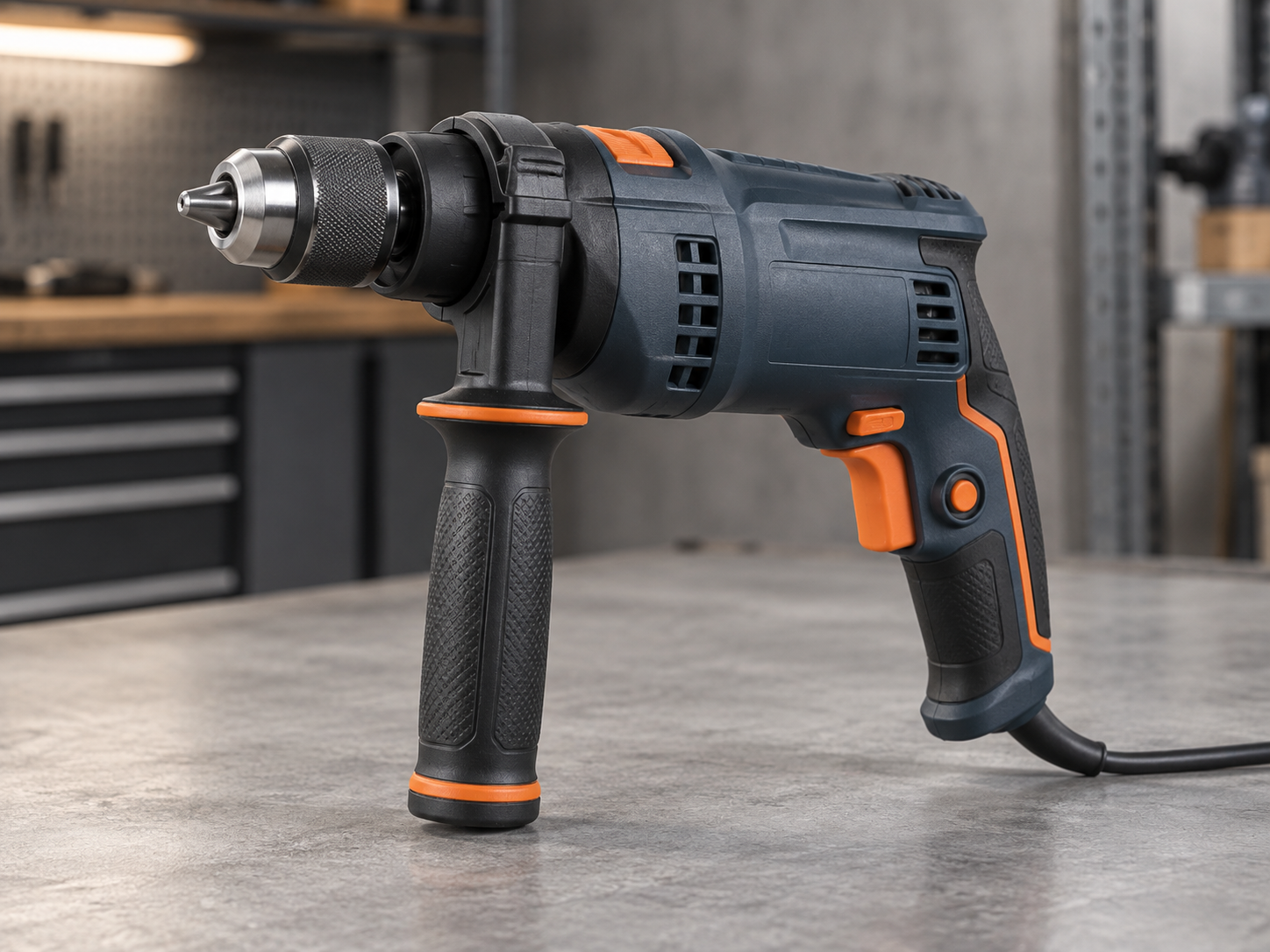
Caption: Torque and speed should be judged with the bit, material and work cycle the customer will use.
Understand no-load speed and working speed
A no-load RPM figure is measured when the tool is not cutting material. Working speed changes as the bit meets resistance. Buyers should therefore avoid treating no-load speed as a promise that the drill will maintain that value in every material. The specification can still be useful for comparing gear ranges and intended applications, but it needs context from a sample test.
Many drill designs use lower and higher gear ranges. A lower range can be useful where greater turning force and controlled progression are needed; a higher range can serve smaller bits and tasks where speed is advantageous. The actual relationship depends on the gear train, motor and control system. Ask the supplier to state whether the quoted torque and RPM belong to the same mode, and whether each number is continuous, peak or no-load.
The product information should make gear choice understandable to the user. A buyer who selects a two-speed model should test how easily a new user can identify the settings, whether the selector engages reliably and whether the manual gives sensible use examples. An extra feature that the customer does not understand has limited commercial value.
Read torque as a controlled claim
Torque can be measured in different conditions. Some listings separate “hard” and “soft” torque, while others present one maximum figure. The labels may reflect different test setups and should not be compared as though they are identical. Ask for the test definition, tool configuration, battery state if cordless, gear, accessory and measurement method behind a claim used in marketing.
Higher torque is not automatically a better match for every buyer. A user driving small fasteners needs control and an appropriate clutch as well as available force. A tool that can produce a high moment but is heavy, abrupt or poorly matched to the fastener may cause more rework. Conversely, a buyer serving large hole saws or demanding driving tasks may need a stronger gear and handling arrangement. The product should be evaluated as a system.
The distinction also helps a salesperson ask better questions. “What are you drilling?” and “What are you fastening?” are more useful than “How much torque do you want?” If the customer cannot answer the latter, a range built around clear application categories can still guide them toward an appropriate model.
Account for the bit and chuck
A sharp, correctly selected bit converts the drill’s rotation into work more efficiently than an unsuitable or worn bit. Metal drilling, wood drilling and masonry drilling use different cutting geometries and operating practices. Bosch Professional’s bit selection explanation illustrates why a material-specific bit matters. The drill’s chuck must also hold the intended shank securely and allow practical bit changes.
During supplier comparison, use the same bit type and comparable condition. Note the chuck capacity, bit fit and whether the bit slips or is difficult to release after the test. If one sample includes a premium accessory and another includes a low-grade generic bit, the comparison primarily tests the accessory difference. A buyer can test both the bare tool with a standard reference bit and the tool as it will actually be sold in a kit.
For private label, consider whether to include bits at all. An included set can help installation preparation and retail value, but only if its material labels, sizes and quality match the product promise. The drill accessory guide gives a practical framework for that decision.
Use sample tests that resemble customer work
Select a small number of representative tasks and document them. For example, record a timber species and thickness, a steel sample and bit, and a series of fasteners in a prepared board. State the selected gear and control setting. Do not compare tools with different task loads or a fully charged battery against one that is nearly empty. The purpose is a repeatable buyer observation, not a laboratory certification claim.
Observe both work output and handling. Does the drill start smoothly? Can the user hold alignment? Is the trigger response predictable? Does the chuck stay secure? Does the tool become uncomfortable during the expected work cycle? These factors can matter more to a customer than a small difference in a nominal figure.
Record limitations as well as successes. If the drill performs well in one material but not another, the product page should make the intended application clear. This avoids an exaggerated all-purpose claim and helps a distributor decide whether it needs a second model to cover the range.
Mid-article sourcing CTA: Comparing drill samples for a distributor range? Send the target materials, bits and work cycle so ToolViron can discuss a configuration and review plan.
Translate observations into a sales specification
A useful specification sheet separates measured, rated and descriptive information. List the supplier’s declared input or platform details, gear ranges, chuck type, included accessories and intended task. Then describe what the buyer observed in its own controlled sample review, with conditions. Avoid presenting an illustrative sample result as a universal performance rating.
For online sales, the first paragraph should help a customer decide whether the tool matches the task. Detailed numbers can follow. For trade distribution, include the accessory and service information needed by sales staff. A single line saying “powerful 80 Nm drill” does not answer whether the product can handle the customer’s chosen bit, fastener or work cycle.
When product variants differ by plug, battery or gearbox, distinguish the SKUs. A test on one configuration cannot automatically validate another. The same applies to a revised supplier model. Keep model identity and version with any performance evidence used in a listing.
Build factory testing around the approved model
Factory testing should confirm the functions and configuration the buyer approved. Ask the supplier what it checks for switch response, gear selection, direction control, chuck operation, appearance, cable or battery connection and accessories. The exact checks depend on the tool. A large generic test list is less useful than a short set linked to the product’s actual features and acceptance criteria.
At shipment inspection, compare the finished tool and retail pack with the approved reference. Verify model and market variant, correct plug or charger where relevant, accessory contents, labels, instructions and carton marks. An inspection of appearance alone will not confirm that the product delivered can support the stated application. The ToolViron quality page can help start a buyer-supplier discussion about inspection checkpoints.

Caption: A review record should link the claimed specification to a configured sample and relevant task.
If a discrepancy appears, identify whether it is a tool function, accessory, labeling or documentation problem. Record the finding, assign a corrective action and confirm the result before dispatch. A supplier process that can explain a finding is more valuable than a vague assurance that all products are tested.
Review the complete commercial offer
Compare quoted price only after each supplier is pricing the same product scope. A package with extra bits, a case or an additional battery is not directly comparable with a bare tool. Neither is a model with a different chuck, plug or gearbox. Document the comparison on a one-page matrix with configuration, target user, performance evidence, included items and service assumptions.
The support plan matters. A buyer needs the correct manual, replacement accessories and a route for customer questions. If the tool is sold for screwdriving, can the sales team explain the clutch? If it is sold for metal drilling, can it recommend an appropriate bit? Good product information reduces unnecessary returns and helps an importer learn what customers actually need.
After the first order, gather feedback by application rather than by broad complaint labels. “Not enough power” might describe an unsuitable bit, the wrong gear, unrealistic customer expectation or a genuine product concern. Trace the model, accessory and use conditions before changing the specification.
Compare endurance without inventing a duty rating
An importer may be tempted to describe a drill as “industrial” because it completes one demanding hole in a demonstration. A better assessment repeats the relevant task with defined pauses, checks tool temperature and user comfort, and records whether performance changes. The result should be framed as an observation under those conditions, not as an unlimited duty-cycle promise. The supplier can then explain what thermal or overload protection the exact model includes, supported by its own documentation.
For cordless drills, include battery identity and charge state in the record. A fresh, high-capacity pack can make one sample look stronger than an otherwise similar kit with a smaller pack. If your retail offer includes the smaller pack, test that pack. A buyer should not approve a bare tool using an oversized engineering battery and then publish the result as if it applied to the shipped kit.
For corded drills, confirm supply voltage and frequency used in the test. An overseas showroom may use a different mains environment from the destination market. The quoted plug, rating plate and manual must correspond to the market configuration being purchased. A performance observation made at one supply condition should not silently become a claim for another.
Build a specification sheet that sales staff can defend
Separate manufacturer-rated values from your own application observations. A useful sheet might show no-load speed by gear, chuck capacity, clutch range if present, battery kit or power rating, and the actual material and bit used for a sample task. Avoid combining a peak-torque figure from one version with an RPM figure from another. Version the sheet alongside the product SKU and approved sample.
If two models have similar headline torque, describe their practical difference with the work they are intended to do: compact installation work, mixed drilling and driving, or heavier repeated holes. Sales staff can explain such a distinction more honestly than an unexplained “professional grade” label. When a customer needs a task outside the demonstrated range, recommend a further sample or another tool category instead of stretching the claim.
Review the product page after launch. If returns cite “not enough power,” investigate the material, bit and technique before assuming a motor defect. Repeated complaints in the same task may indicate that the original positioning was too broad. Feed that learning into both the next sample test and the marketing description.
Frequently asked questions
Does higher RPM mean a drill is more powerful?
No. No-load RPM describes rotational speed in a stated condition. Drilling performance also depends on turning force, gear, bit, material and control. Compare drills under the same intended application rather than sorting by one figure.
Is maximum torque enough to compare two drill drivers?
No. Confirm how each supplier defines the torque claim, which gear and power configuration it used, and how the tool behaves in representative drilling or fastening work.
Why does a drill slow down under load?
Working speed changes when the bit encounters resistance. The amount of change depends on the tool configuration, material, bit condition and operating mode. A no-load speed number is not a constant working-speed promise.
What should a buyer record during a drill sample test?
Record tool model and configuration, power source, gear, bit, material, hole or fastener specification, observed behavior, operator feedback and any limitation. Keep the record with sample approval.
Conclusion
Torque and RPM are useful inputs when their definitions and test conditions are clear. They should not replace an application-led sample review. Define the user’s job, use comparable accessories and material, examine handling and control, and document the exact configuration before a claim appears in the catalog.
Send your requirements
Share your target application, market, bit or fastener sizes, required gear arrangement and order plan. ToolViron can discuss a drill configuration and factory testing approach. Send your requirements to begin.
Images illustrate product and inspection topics; they are not documentary evidence of a specific ToolViron test or customer project. Confirm the exact model and market requirements before ordering.