
A private-label buyer sends a photograph of one drill and asks for quotations for three countries. The tool body may look the same in each market, but the saleable products can differ in plug, voltage, charger, manual language, rating label, carton marks, accessories and documentation. If these differences are hidden in emails, a supplier can quote one configuration and ship another. A regional SKU matrix turns the discussion into a controlled product plan.
For EU markets, the European Commission's general product-compliance guidance reminds importers to check documentation, marking and traceability duties. This article does not claim that one matrix replaces legal analysis. Requirements vary by product and destination, so qualified local review remains necessary.
Begin with one controlled base model
Identify the common tool platform: motor and drive, housing, intended application, guard or chuck, switch, battery interface if any, and the core technical documentation. Then list every element that can differ by market or sales channel. The distinction prevents unnecessary duplication of engineering work while keeping customer-visible differences explicit.
Do not use a color change alone as a new technical model, nor assume the same internal design means the same saleable SKU. A kit with a different charger, chain, blade or guard can have different instructions and inspection needs. The matrix should reflect the actual product shipped, not only the factory's internal model number.
The voltage and plug selection guide addresses one dimension in detail. A SKU matrix connects that electrical choice to packaging, manuals, accessories, labels and pricing.
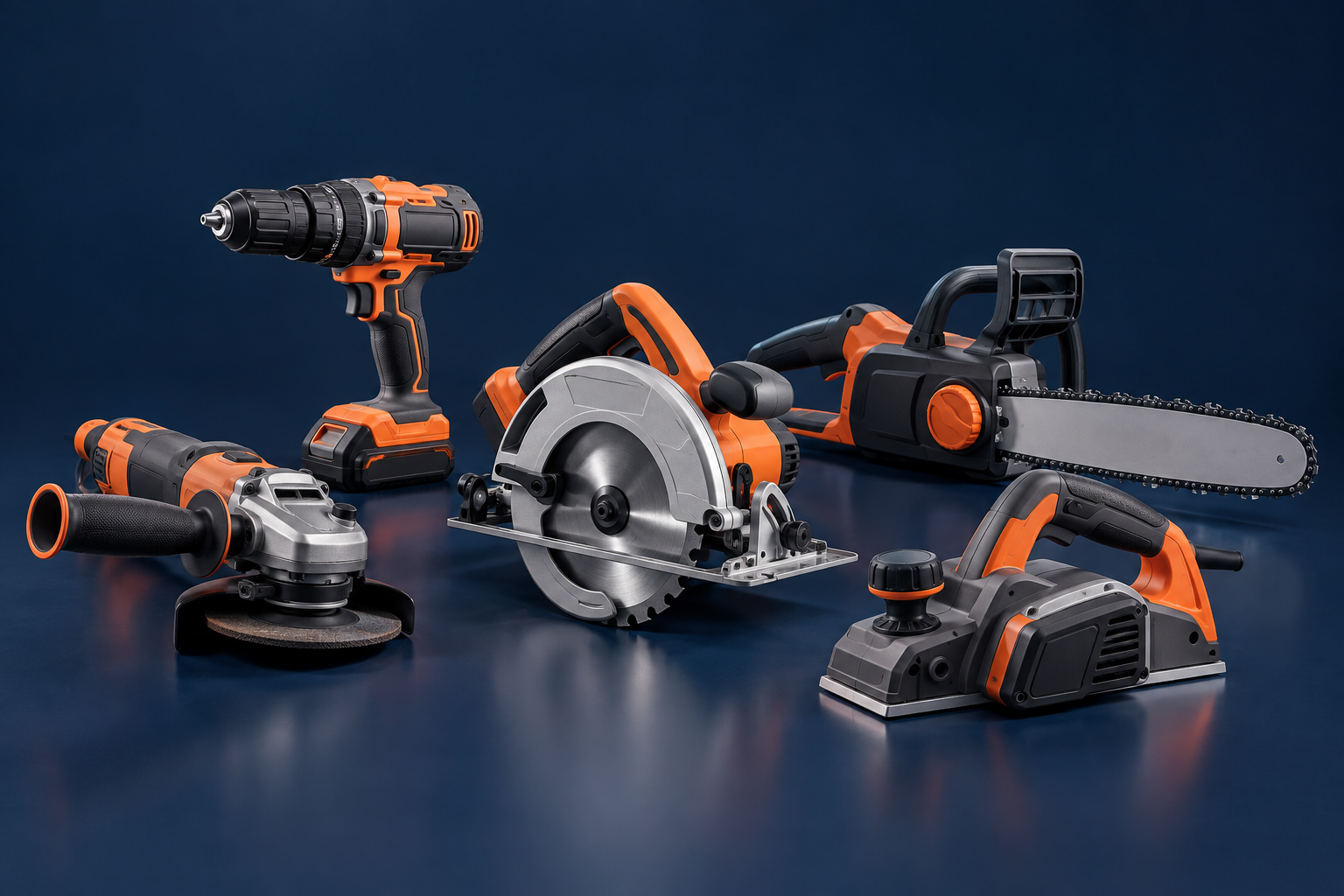
Caption: Visually similar tools can represent different market-specific saleable configurations.
Choose fields that prevent real mistakes
A useful matrix includes market, selling channel, brand, saleable SKU, base model and revision, rated input or battery platform, plug or charger, supplied accessories, guard or cutting system, manual languages, product and carton labels, packaging artwork, test or conformity file reference, barcode and supplier quotation reference. Add owner and approval date for each row.
Do not turn the matrix into an uncontrolled spreadsheet with 50 columns nobody checks. Mark which fields are mandatory for every product and which apply only to a chainsaw, grinder, drill or planer. A chainsaw row may need bar and chain identifiers; a planer row may need blade and fence kit; a cordless drill row needs battery and charger pairing.
Use exact part numbers where possible. “EU charger” or “standard blade” can mean different things to purchasing, engineering and packing. If a field is still open, mark it as open and block the relevant release gate rather than fill it with a guess. A blank resolved honestly is safer than a copied value from another market.
Connect the matrix to the quotation
Ask suppliers to quote by SKU row or by a clearly identified variant set. The quotation should state which components and services are included: tool, accessories, manuals, artwork, certification or test work, retail carton, master carton and shipment terms. This prevents a low price for a bare tool being compared against a complete kit.
Volume and minimum order may differ by variant. A buyer may combine common base-model production with smaller market-specific packing runs, but only if the supplier can control variant identity and the commercial arrangement is clear. Do not assume a single MOQ for all markets or that any logo and plug change is free.
The landed-cost comparison article explains why final programme cost depends on more than unit price. The matrix supplies the configuration definitions needed to compare those costs fairly.
Approve an exact sample for each material difference
One engineering sample can demonstrate the common platform, but each saleable variant should be reviewed for the differences that matter. A regional charger or mains plug requires physical and documentation checks. A manual-language change requires proofing. A cutting-system change may need an application test. The buyer and supplier should agree when one representative test can cover several variants and document why.
Record which sample, artwork and test report supports each matrix row. If a document covers only one voltage or model revision, do not attach it indiscriminately to every SKU. A “certificate available” cell is not enough; the product identity and scope must be checked.
The pilot production run guide provides a gate after sample approval. Use the matrix to select pilot cartons so the line exercises the variants most likely to be confused. A production route that can assemble the common tool but mispack two similar chargers has not proven the regional offer.
Mid-article sourcing CTA: Quoting the same power-tool platform for multiple markets? Send the destination countries, power variants and intended kits for a controlled SKU discussion.
Design the packing and inventory controls
Give each variant a distinct finished-goods identifier and barcode where required by the channel. Use pick lists and carton labels that operators can distinguish reliably. Two chargers of the same color should not be separated only by a tiny technical code that is hard to see at packing speed. Physical layout or scanning can reduce errors, depending on the factory process.
Track component and finished-kit lots so a wrong-market pack can be located if discovered after shipment. A master carton should not contain mixed variants unless that mix is explicitly ordered and marked. The lot-traceability article helps with the identity chain from component to customer shipment.
At final inspection, select cartons from every market variant in the order. Check the tool label, plug or charger, manual language, accessories and retail carton against the matrix. Sampling only the largest variant can miss a critical error in a smaller market run.
Control changes after launch
A supplier may discontinue a charger, update a switch or revise an accessory. The matrix should show which SKUs are affected, whether old and new parts are interchangeable and which manuals, labels or reports need review. Change control is especially important when a common component feeds multiple regional kits. One engineering change can affect several markets at once.
Marketing changes also need control. A new “two-battery promotion” is a new saleable configuration for packing, pricing, weight and customer information, even if the drill body stays the same. Create a row or revision rather than slipping an extra battery into an existing SKU without a record.
Schedule periodic reviews. A matrix created at launch can become misleading if suppliers and channels change. Assign one product owner to approve revisions and communicate them to purchasing, factory, quality, sales and service teams. Version history should show what changed and when.
Make after-sales lookup possible
Customer support needs to identify the correct manual, battery, charger, guard, bar or blade from the saleable SKU and serial or lot. If all variants share one vague model name, a service agent may send a wrong-market part. Connect the matrix to spare-parts records and warranty intake.
Train retail partners on the differences that matter to end users. They do not need the whole internal spreadsheet, but they should know box contents and market-specific power requirements. A concise customer-facing specification table can prevent wrong-region purchases and returns.
If a customer reports a mismatch, compare the physical carton with the matrix revision active when it was packed. This distinguishes a packing error from outdated website copy. The correction may be in production, inventory allocation or marketing; the record makes that decision possible.
Prevent a matrix from becoming a stale spreadsheet
Assign a controlled owner and a version number. The latest approved matrix should be the one purchasing, factory packing, quality, sales and service use. Archive superseded versions rather than overwrite them, because a customer with an older tool may need the original charger or manual. A change record should say who approved it, when it took effect and which production lots were affected.
Access rules matter. Sales may be able to view the matrix while only product and quality owners can change technical fields. Artwork teams can propose language updates without silently editing rated voltage. If the file is emailed around as many uncontrolled copies, the factory may build from an old version. A shared controlled source with clear release status is more valuable than a visually elaborate table.
Review the matrix before each order and after any component or market change. “Same as last time” should be confirmed against the current record, not inferred from an old invoice.
Test two variants that are easy to confuse
Choose the pair of regional SKUs with the closest appearance and different critical contents. Give a trained picker the relevant work instruction and ask them to prepare several kits from mixed component bins under normal conditions. Check whether the right plug, charger, manual and label are selected. The purpose is to reveal process weakness before a full production run, not to blame an individual operator.
If errors occur, consider stronger physical separation, clearer part marking, scanning or a revised packing sequence. A second person checking a printed list may help, but the best control depends on volume and risk. Repeat the trial after changing the process. Keep the error and correction in the pilot record.
For large programmes, repeat the check at line changeover. The first cartons after switching markets are often the most revealing because old materials may remain at the station.
Clarify what test evidence covers
The matrix should point to technical reports by exact model and configuration. If one test covers several variants, document the engineering rationale and the features held constant. If a different voltage, charger, guard or cutting system changes the product, ask qualified specialists whether new assessment is needed. Do not treat a shared housing as automatic evidence equivalence.
External buyers and inspectors should receive the scope they need, not merely a green “certified” cell. Include report identifier, date, relevant model, and any limitations. A report for a bare tool does not necessarily cover a later battery-and-charger bundle. A label proof in English does not approve a translated warning for another market.
This discipline is also useful for AI-readable product information: a clear variant table lets a buyer or agent distinguish what is included without inferring from a generic product image. It should serve humans first and be easy to parse because it is precise.
Make a commercial decision from the matrix
The buyer can see where variant complexity costs money. A shared base tool with three plugs and languages may be manageable; five small variants with different accessories, case inserts and spare parts may fragment stock and service. Compare expected demand, MOQ, setup and after-sales burden for each row before expanding the range.
Some markets may justify a dedicated kit; others may be better served by a smaller compliant assortment. The matrix does not choose the strategy, but it reveals the cost and risk of each choice. Remove a proposed SKU only after considering customer requirements, not because its row looks inconvenient.
When a quote changes, compare the complete affected rows. A price reduction that silently removes a charger, fence or protective case is not a like-for-like saving. The matrix makes that visible before a purchase order is signed.
Keep the product page aligned with the row
The public listing should use the same saleable SKU, power arrangement and box contents as the controlled matrix. If a marketplace clones a listing across regions, review the plug, charger, manual language and accessories in each clone before it goes live. A perfect factory matrix cannot prevent a customer from ordering the wrong variant if the website describes all rows with one generic photograph.
When a regional listing changes, assign an owner to compare its visible claims and images with the approved matrix before publication. That review is especially important when the physical tool looks identical but the plug, charger or included accessories differ.
Frequently asked questions
Can one SKU cover every destination market?
Only if the actual product, power arrangement, labels, instructions and channel requirements genuinely match. Visual similarity is not enough. Use a matrix to identify and control any material differences.
Does a different carton language require a new engineering test?
Not automatically, but it does require artwork and information review, and the buyer should assess whether the changed market has other product or documentation requirements. Record the rationale for any shared test evidence.
How should a supplier quote regional variants?
Quote against defined matrix rows, showing included parts, packing, documentation work, quantities and lead times. This allows like-for-like comparison and reduces assumptions hidden in a headline unit price.
What should pre-shipment inspection sample?
Sample each saleable variant and check the physical tool, power components, accessories, manual, labels and carton against its approved row. Do not infer smaller variants are correct from the largest run.
Conclusion
A market SKU matrix makes regional differences visible before they become quotation, packing or service errors. Define the common platform, control the changing fields, link every row to its evidence and inspect each variant before shipment. It is a practical bridge between technical approval and what the customer actually receives.
Send your requirements
Share the tool categories and markets in your planned range. ToolViron can discuss a clear variant matrix and the sample, factory and shipment checks needed for each saleable SKU. Send your requirements to begin.

Caption: Final packing checks should verify the exact regional variant, not just the base tool.
Images illustrate product and inspection topics; they are not documentary evidence of a specific ToolViron test or customer project. Confirm the exact model and market requirements before ordering.