
A corded electric planer is often chosen for predictable power in a workshop or on a fitting job. Yet the cable can be overlooked until it snags on the board, pulls the tool near the end of a pass or crosses the cutting path. Good cord management is not only a safety topic; it affects finish quality, work rhythm and how confidently a first-time buyer can use the product. Importers should evaluate the cable, plug and user guidance as part of the planer offer.
This article is a range-planning and setup guide, not a substitute for workplace electrical rules. OSHA's portable-tool safety guide discusses inspection and safe handling of powered tools in U.S. workplaces. The exact planer manual and local requirements govern cable condition, power supply and permitted accessories.
Start with the work area
Define whether the planer is used on a fixed bench, in a joinery workshop, on doors still in place or at a temporary installation site. Workpiece support and cable route differ. A long board may require infeed and outfeed space; a door edge in a tight room can leave little room for the operator and cord. The buyer should test the environment the target customer actually faces.
Consider the complete power path: tool cable, regional plug, outlet location and any approved extension lead. A longer tool cord may reduce dependence on an extension but create more cable to manage. A shorter one may be convenient at a fixed bench but restrictive on site. Do not choose length from a catalogue number alone; assess the typical workspace and applicable electrical guidance.
The corded planer woodworking guide covers the broader platform choice. Here the specific question is whether the cable arrangement supports safe, controlled passes on the intended workpiece.
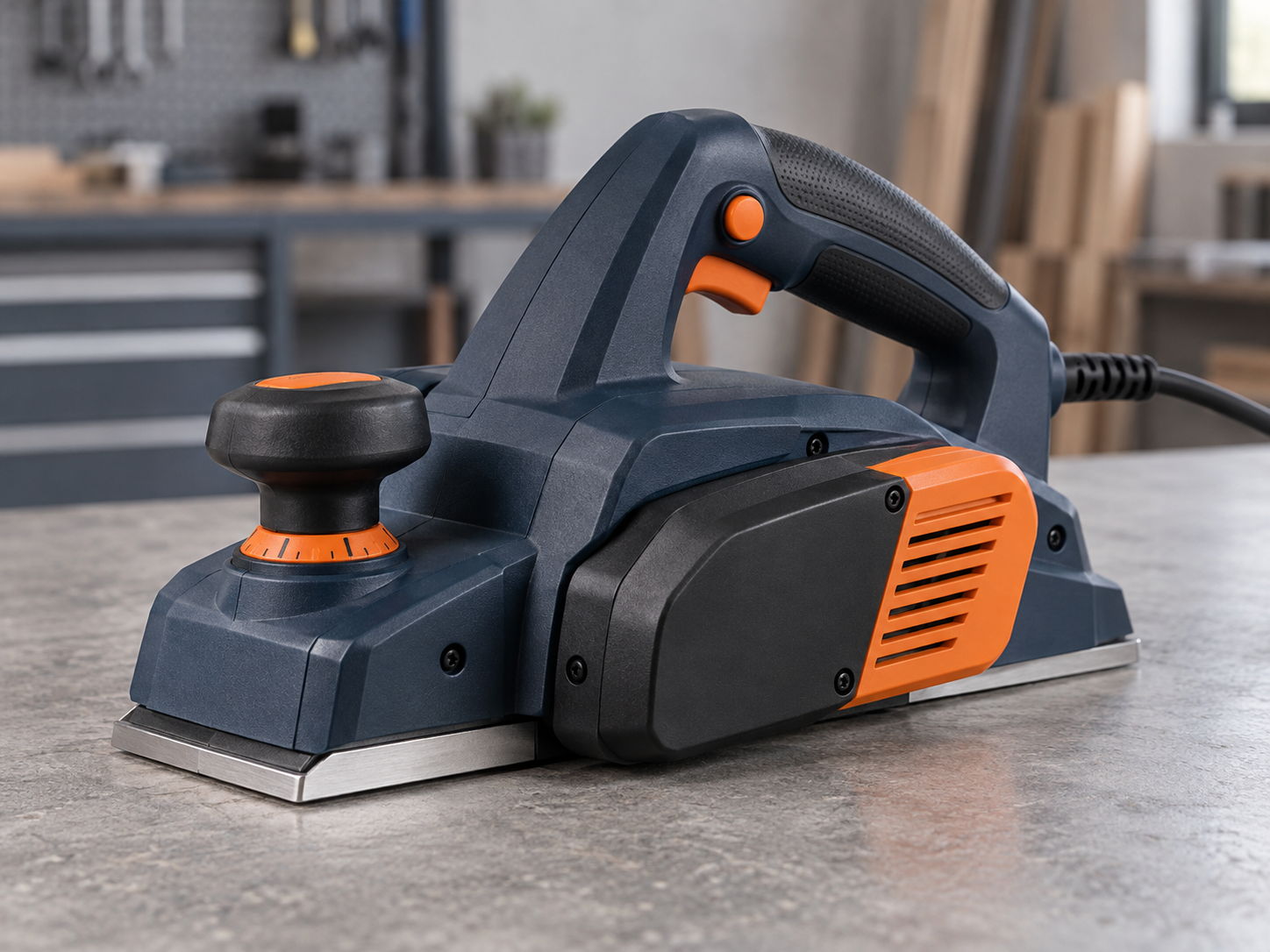
Caption: The approved cable route should stay clear of the cutter and supported workpiece.
Inspect the cable and strain relief as components
At sample approval, examine cable length, flexibility, insulation condition, plug, strain relief and exit direction. Does the cable kink sharply at the housing? Can it be routed away from the cut without pulling on the operator's hand? A cable that looks fine coiled in the carton may be awkward when the planer is used at full reach.
Check the plug and voltage for the destination market. A private-label importer should not assume the factory's standard plug will suit every country. The tool label, manual and carton should identify the exact regional variant. A last-minute plug substitution can affect packing and safety documentation and should go through controlled approval.
The cable must not be treated as a handle or used to pull the tool from the work area. Product information should show a sensible route and state any permitted extension-cord requirements from the manual. If a cable is damaged, the customer needs an authorized service route. Electrical tape is not a product-support strategy.
Prepare the workpiece before power is connected
A stable board is essential. Secure the workpiece and make room for the planer to approach, travel and exit without hitting a clamp or running out of support. Identify any hidden nails, screws or other objects that could strike the blades. Plan where chips will eject and whether a dust bag or extractor will be used. The cable route should be checked against all those elements.
An overhead or vertical task should be assessed separately from a horizontal bench pass. Do not depict a planer used in an awkward orientation unless the manual permits it and the setup is safe. The buyer should select use-case photography that reflects real work, not a dramatic but implausible cutting pose.
The chip-ejection and dust-collection guide is relevant because a hose and cable can interfere with each other. A sample test should check both together if the customer is expected to use extraction.
Build a realistic sample sequence
Have trained reviewers plan a complete pass with the tool isolated: secure the board, choose the outlet, route the cable and position any hose. Observe whether the cable stays behind the intended travel direction and whether there is enough slack for the full pass. This non-powered rehearsal can reveal a bad exit angle without exposing anyone to a moving blade.
Then perform a controlled powered task within the manual's guidance. Use a representative board, depth and number of passes. Record whether the cable catches on a clamp, drags over the workpiece, pulls the tool near the exit or obstructs the switch hand. The outcome should include surface quality and handling notes, not only that the motor operated.
Try the tool with the actual bundled bag, hose adaptor or fence. An accessory may occupy the same space needed for the cable. If a repositioning feature exists, test it on the saleable model. Do not claim a cable-management advantage from a prototype or a different revision.
Mid-article sourcing CTA: Planning a corded planer for a workshop or installer range? Send the workpiece, outlet setup and required accessories for a realistic sample review.
Write buyer-facing guidance without overpromising
A concise setup panel can show the workpiece supported, cord and hose routed clear, and the operator using the tool according to its manual. It should state the actual cord length and plug variant. If an extension lead is needed in a typical installation, explain that its selection must follow the tool instructions and local electrical requirements.
Do not market a tool as “safe for all workshop layouts.” Every workspace has different trip, pinch and electrical hazards. Instead, describe the features the user can evaluate: cable exit, strain relief, length and approved accessories. A technical distributor can then advise on the specific project.
Use imagery carefully. A generated photograph with a cable crossing beneath the cutter would teach the wrong setup. The two visuals proposed for this article should show clear routing and a secured board, not claim to document a real ToolViron factory trial.
Keep the shipped variant controlled
At pilot production, confirm the cable specification, plug, strain relief and carton coil arrangement. A different cable supplier or material can change flexibility and handling. A different plug can change market approval and packing. These are not cosmetic substitutions; document them under supplier change control.
At shipment inspection, sample cable appearance and length, plug variant, label and manual. Check that the cable has not been sharply trapped by packaging. A final functional check should follow the approved method and not require pulling the cable through a powered cutter area.
If complaints arrive, distinguish a damaged cable, inconvenient length, snagging caused by worksite setup and a housing or strain-relief defect. Several identical complaints from one batch may point to a supplier or assembly issue. A single difficult site may instead call for clearer guidance or a different product configuration.
Compare cable configurations through a full task
A buyer can set up two production-intent samples with different approved cable lengths or exit designs and perform the same board sequence. Record outlet position, board length, number of passes, cable contact with clamps or workpiece and any interruptions. The trial should include the actual dust bag or hose if the saleable kit includes it. A five-second no-load hold will not reveal whether the cable pulls the tool at the end of a long pass.
Do not choose the “winner” solely by longer reach. Extra cable can lie across a bench, catch underfoot or complicate packing. A flexible, well-placed shorter cable may suit a fixed workshop better. If the channel includes field installers, define their typical outlet distance and any model-specific extension-cord guidance separately.
An observed handling advantage should remain tied to the test setup. A different workbench layout could reverse it. The aim is to find a configuration that works reliably for the target user, not to prove a universal cable length.
Include the cable in the quality file
Specify cable material and cross-section, length tolerance, plug, strain relief, labeling and approved supplier according to product engineering and market review. A buyer need not design the electrical system, but should ensure the configuration is written and controlled. The same housing can be sold with different power leads; each regional SKU must be inspectable.
At incoming inspection, a factory can verify the received cable and plug against the approved record. At assembly, it can check routing and strain relief. At final inspection, it can check appearance and function. At shipment, the importer can confirm the right variant and that the coil has not been crushed by packing. These are distinct checkpoints, not one generic “cable okay” box.
If a cable supplier changes, review flexibility and handling as well as electrical documentation. A nominally equivalent replacement might bend differently at the exit and affect the very application trial used to approve the product.
Prepare a safe customer-support route
Customers may report that the planer loses power when the cord moves, that the plug is wrong for the region, or that the cable snags in a particular task. These are different cases. The first could indicate damage requiring stop-use and qualified service; the second is a configuration or fulfillment error; the third may require improved guidance or a different product option.
Support should not ask a customer to bend a powered cable repeatedly to reproduce a fault. Request photographs of the unplugged tool and connector, record the serial or lot and provide the proper service path. A recurring cable failure in one lot deserves immediate supplier investigation and possibly broader containment.
When a listing shows a planer connected to a vacuum, make clear which hose, adaptor and extractor are included. Missing accessories can turn a reasonable cable route in the photo into an impossible real setup.
Consider shipping and storage effects
The cable may be tightly coiled inside the case for months. Check whether the packing method creates kinks or presses the cord against a blade, fastener or sharp insert edge. A carton drop or vibration assessment should use the finished kit, not an empty tool shell. Unpack pilot cartons after the test and inspect the cable and strain relief.
Retail display tools also have a different handling history from unopened stock. A demonstration cable can be stepped on, pulled or recoiled many times. Store staff should inspect it under their workplace procedure and never return a worn display tool to saleable stock without a documented decision.
A full-length trial reveals hidden snags
For a site-fitting buyer, a short board trial may miss what happens when the operator moves along a long door or timber edge. Set up a board that reflects the customer's full travel distance, with the approved outlet, dust attachment and clamps. Mark where the cable or hose approaches the workpiece, then perform a controlled pass with trained personnel. A snag at the last few centimeters can spoil the entire cut.
Repeat after moving the outlet to another realistic position. If the cable route only works with a conveniently placed socket directly behind the operator, the retail guidance should not imply that the tool is equally convenient in every site layout. The test can inform a different cable exit, longer cord or a support accessory, depending on engineering approval.
A customer-facing boundary
The listing should describe the actual cable and plug, not promise safe operation with any extension lead. It can show a clear example of a supported board and cord routed away from the cutter, while directing users to the manual and local electrical rules for their specific setup. This is more useful than a staged photograph in which the cable disappears behind the tool.
If the customer reports a damaged cord, stop-use and qualified service guidance should be prominent. Troubleshooting should not ask them to repeatedly flex the powered cable to reproduce an intermittent connection. This simple boundary protects both the user and the credibility of the product-support team.
Frequently asked questions
Is a longer planer cable always better?
No. It can improve reach but also add cable to manage. Evaluate the typical workspace, outlet position, packaging and local electrical rules before choosing length.
Can a customer replace a damaged cable with any similar cord?
No. Use the manufacturer's approved service procedure and parts, carried out by qualified personnel where required. A visually similar cord may not meet the tool's specification.
Should a sample test include a dust-extraction hose?
Yes, if the saleable product is promoted for hose-connected use. The hose and cable can compete for space and affect handling during a full pass.
What should shipment inspection check?
Confirm the approved regional plug, cable and strain relief, physical condition, manual and carton packing. Match the result to the exact SKU and market.
Conclusion
Cord management belongs in the planer buying brief because it affects both safety and cut quality. Review the full work area, cable and accessory route, then test a complete representative pass. Clear first-use guidance and controlled regional variants make the product easier to sell and support.
Send your requirements
Share your target workshop or installation setting, market and required planer accessories. ToolViron can discuss the cable and packing configuration to validate before an OEM order. Send your requirements to begin.

Caption: Cable and plug details are part of the approved market-specific carton.
Images illustrate product and inspection topics; they are not documentary evidence of a specific ToolViron test or customer project. Confirm the exact model and market requirements before ordering.