
An electric planer removes material quickly, and that material has to go somewhere. Chip ejection direction, bag capacity and extraction connection affect whether the tool works comfortably at a door, bench or installation site. A buyer evaluating a planer should treat chip management as a product-system decision, not a small accessory detail.
This guide is for distributors and importers comparing electric planer configurations. It identifies practical sample tests and the product information needed to avoid “dust-free” promises that a bag or port cannot support.
Identify the actual work setting
Planing a door edge in a finished interior raises different clean-up concerns from shaping timber at an open workshop bench. Ask whether customers work left- or right-handed, whether they operate near a wall, and whether an extractor is available. The useful ejection direction can change with the workpiece orientation and operator stance.
Some planers offer selectable left/right chip ejection; others have a fixed outlet. Do not quote a selectable feature unless the exact SKU includes it. Even when the direction can be changed, verify that the selector is understandable and does not obstruct grip, the fence or the intended depth adjustment.
The door-fitting workflow guide explains why site preparation and a secured workpiece matter. Chip collection is one part of that workflow, not a replacement for eye protection or clean working practice.
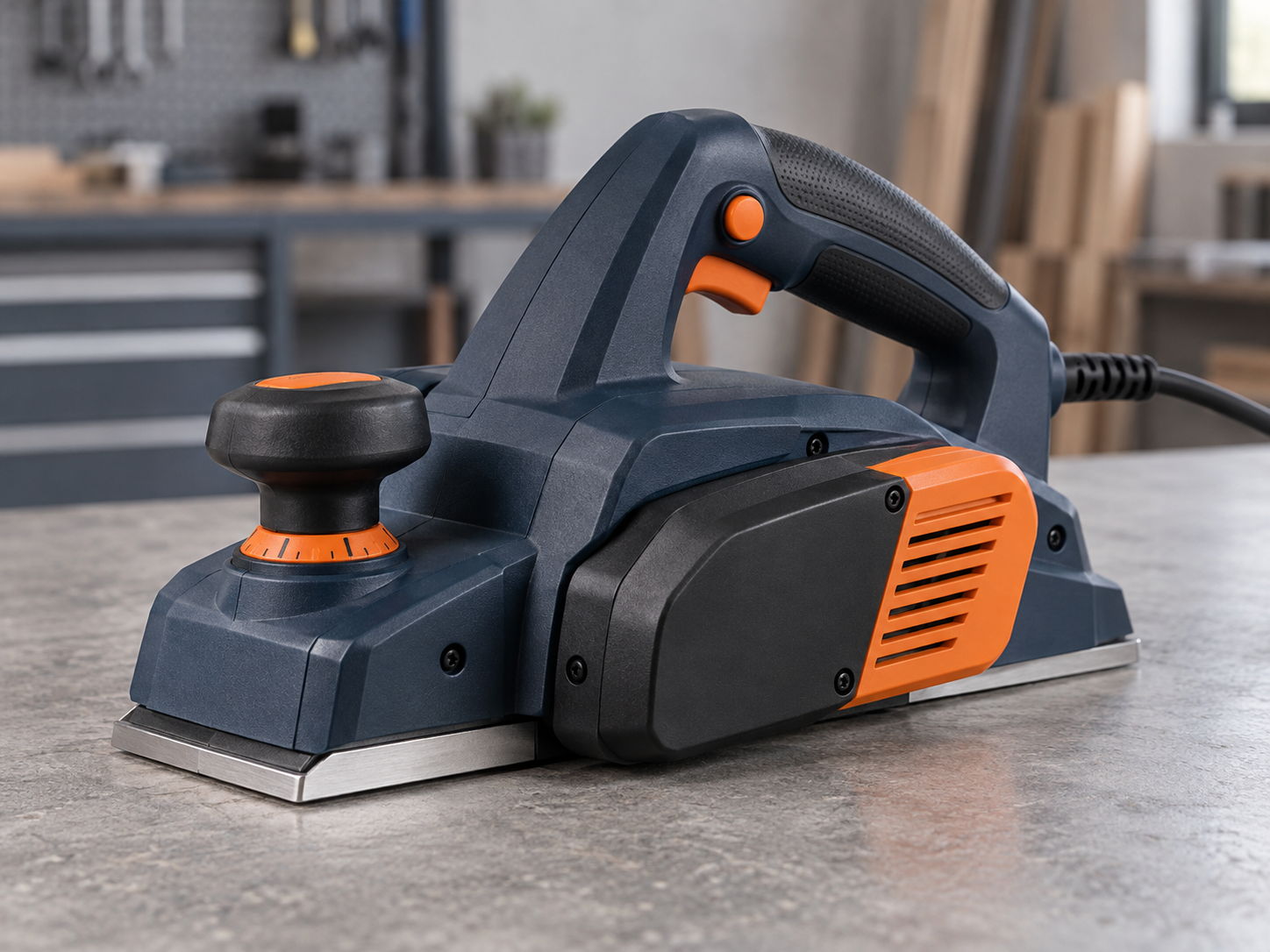
Caption: Chip exit should be reviewed in the position and material the customer will actually use.
Compare a collection bag with extraction
A small collection bag may be convenient for short cuts when no extractor is available. Its effectiveness varies with bag design, wood species, chip size, cutting depth and how full it is. It can also affect tool balance or interfere with a wall. Ask whether the bag is included, how it attaches and how it is emptied.
An extraction port can connect to a suitable dust collector if the interface is compatible. Record the outlet diameter and any adapter supplied. Do not describe the port as universally compatible with all vacuums. Hose weight and routing can pull the tool off line on a narrow door edge; test the setup with the hose arrangement likely to be used.
Neither a bag nor a vacuum connection means the work is dust-free. Fine airborne particles can remain, and workplace exposure controls depend on the material and location. The retailer should avoid unsupported health or compliance claims and follow local guidance applicable to woodworking dust.
Test for clogging and interference
Set a defined cutting depth and plane representative timber over a recorded number of passes. Observe chip flow, outlet blockage, bag fill and any material build-up near the blade. Repeat for more than one wood condition if the target market uses both dry and resinous timber. A single clean pass on a new machine is not enough to understand the customer's maintenance burden.
Examine whether the outlet remains accessible for cleaning after the tool is isolated from power. The manual should explain safe clearing and blade-area maintenance. A product photo should not encourage a user to put a hand near a moving drum to remove chips.
If the planer includes a fence or rebate guide, test chip management with that accessory installed. A hose or bag that works in a straight pass may conflict with the guide used for an edge task. The rabbet-and-chamfer guide covers those feature interactions.
Mid-article sourcing CTA: Comparing planer collection options? Send the main wood type, work setting and preferred extractor interface for a model-specific sample plan.
Document the packed configuration
List the bag, adapter, hose connector and any cap or direction selector in the approved bill of materials. Photograph them assembled and laid out separately. The box-contents list and retail images must match the shipment. “Dust collection ready” can be acceptable only when the interface and separately required equipment are explained clearly.
At factory testing, record chip-ejection direction and whether the outlet remains clear in the defined sample cut. During shipment inspection, verify the actual bag or adapter part IDs, not just the presence of a generic plastic attachment. A substitute can fit loosely and leak or detach in use.
Makita's KP0810 planer specification is an example of model-specific accessory and configuration information. Its features should not be attributed to a different product. Use the approved ToolViron model specification for any retail claim.
Prepare for replacement and customer questions
Bags wear, zips fail and adapters get lost. Ask whether replacements can be ordered separately and under which model numbers. Customer support should be able to answer whether a given extractor connection needs an adapter and whether it is supplied. Avoid replying with an improvised fit recommendation when the tool was not tested with that connection.
An FAQ in the product listing can explain how the chip direction is selected, what collection item is included and why users still need suitable housekeeping and protective measures. Keep the detailed procedure in the manual. The ToolViron planer range can be linked to the exact SKU and accessory sheet when available.
Assess the collection system through a full job
A short demonstration can make a bag look effective because it has not yet filled. Plan a defined sequence of passes and observe what happens as chips accumulate. Does the bag sag into the workpiece, detach, block the outlet or become awkward to empty? Record the timber, cutting depth and duration. The goal is not to invent a collection efficiency percentage but to understand ordinary usability.
For extraction, use the adapter and hose the customer is likely to own. Check whether the hose pulls at the port when the planer reaches the end of a pass and whether the operator can keep it clear of the cutting path. The tool may work well at a bench yet be awkward when trimming a vertical door edge. A buyer should test both if both are claimed applications.
Ask how the manual instructs users to clear a blocked outlet after isolating power. If the only practical method seems to require reaching near the blade drum, escalate the design and instruction issue. Support staff should not invent a clearing procedure after the product is sold.
Design two honest retail variants
One variant can be a basic planer with an outlet and clear information on optional extraction components. Another can include an approved bag or adapter for site work. Price and photograph them separately. The buyer should not assume a professional user values an included small bag if they prefer to connect a workshop extractor, nor assume a homeowner owns a compatible vacuum.
Keep the accessory identifier visible in the product data. A later change in outlet moulding or bag collar can affect compatibility. During shipment inspection, compare the actual attachment with the retained sample rather than merely counting “one bag.” A loose fit can create customer complaints that look like poor dust collection but actually begin with a substituted part.
Customer support should ask whether the bag is full, which adapter is used and whether the outlet is blocked before diagnosing a fault. If several customers report the same problem, review the design and instructions rather than treating each case independently.
Evaluate the work area after the cut
Chip management should be reviewed not only while the planer runs but also after it stops. Where did larger chips collect? Did fine dust settle on adjacent surfaces? Can the bag be removed without spilling its contents? Does a hose adapter remain attached when the tool is put down? These observations influence the customer's sense of control and the time required to clean a finished space.
Use photographs of the same work area before and after a defined task, but do not turn visual cleanliness into a quantified exposure claim. Airborne particles may not be visible, and dust-control obligations depend on material and jurisdiction. The buyer can use the comparison to improve product design and instructions while keeping health statements appropriately bounded.
Ask whether the user can inspect and clean the collection path safely after isolating power. If the bag zipper, port latch or direction selector is fragile, this may surface only after repeated emptying. A sample cycle of attachment, removal and cleaning can reveal problems without pretending to be a full lifetime test.
Align the feature with after-sales support
The bag and adapter should have independent part numbers where they can be replaced. If an outlet moulding changes between revisions, record which bag collar fits each version. A photograph in the service register is helpful because a few millimetres of difference may not be obvious from a broad part description.
Retailers may want to stock a universal vacuum adapter. Require a physical fit check with the approved planer and common hose sizes in the market before making that claim. If the connection requires a particular third-party component, state it as a compatibility condition rather than implying it is supplied.
After launch, classify customer questions. “Bag fills quickly” may be expected in a heavy removal task, while “bag falls off” can indicate a poor fit or substituted part. Support should gather the timber, cutting setting, accessory ID and use pattern. This evidence helps the importer decide whether the problem is product design, channel positioning or instructions.
Example: an occupied-site installation range
Suppose a retailer targets installers who trim doors in occupied homes. The planer may be technically capable of the cut, but the customer also needs to protect nearby surfaces and control chips. Compare a basic bag configuration with an extraction adapter using the same door-edge sample. Record setup time, interference with the pass, visible chips left behind and how the collection item is emptied or disconnected.
The result may not have a single winner. A bag can be convenient for a short adjustment where a large extractor is unavailable; an extractor can be more appropriate when repeated work justifies the equipment. The buyer can offer one base tool with clearly documented compatible options, or two kit variants. What matters is that the product description states exactly what is included and what the customer still needs.
Do not use a photograph of a pristine room after one pass to imply that no cleanup or fine-dust control is required. A more useful image shows the actual bag or hose connection and a realistically prepared work area. If the image is generated, label it as illustrative rather than an actual customer installation.
Supplier questions before bundle approval
Ask whether the chip outlet can be configured for left or right ejection on the exact model, and what changes when the fence is installed. Request the adapter dimensions and a physical sample, not a “standard port” description. Ask whether the bag material, collar and closure have been tested through repeated attachment cycles.
Check replacement availability. A lost bag or cracked adapter should have a part number and price. If an outlet redesign is planned, ask whether the old accessories will still fit. During shipment inspection, confirm not just that a bag is present but that it attaches securely to the actual planer in that batch.
These questions help the importer avoid a common hidden cost: customers who are satisfied with the cut but return the tool because the promised collection system is awkward or incomplete.
A final sample record for chip management
Photograph the outlet, bag or adapter attached to the actual production-representative planer. Record the timber, cutting setting, number of passes and whether the collection accessory stayed in place, obstructed grip or required clearing. Add the part IDs and whether each item is included or optional. The record should be modest about fine dust; visual observations are not an occupational exposure measurement.
Review the packaging and website together. If the lead image shows a hose connection, the product copy should say what adapter is needed and whether it is supplied. If a bag is included, the box-contents list should identify it and the manual should explain safe attachment and emptying. A missing adapter in a shipment can make an otherwise good planer feel unfinished.
When a supplier changes the outlet moulding, repeat the fit check. A small dimensional change can invalidate the bag or adapter already stocked by overseas retailers. Keep both old and new accessory compatibility visible in support records.
Frequently asked questions
Does an electric planer need a dust bag?
Not in every configuration, but chip management should be planned for the intended work. A bag may help with short jobs, while an extractor can suit some workshop settings if compatible.
Is a chip bag the same as dust extraction?
No. A small bag collects some ejected chips; it does not guarantee capture of fine airborne dust or satisfy every workplace requirement.
Can any shop vacuum connect to a planer port?
No. Check outlet size, adapter fit, hose routing and the approved tool instructions. Avoid “universal” claims without verified compatibility.
Why test with a fence or guide installed?
Accessories can alter the working position and interfere with a bag or hose. Test the actual customer configuration.
Conclusion
Chip management influences user comfort, finish-area cleanliness and service questions. Buyers should define the work setting, test the actual bag or extraction connection and make packed contents explicit. A clear, modest claim serves customers better than an unsupported “dust-free” promise.
End-of-article CTA: Ask ToolViron for a planer catalogue and chip-management configuration review. Tell us whether your customers work mainly on installation sites or workshop benches and which accessories you expect in the box.

Caption: Check the approved bag or adapter against the shipment bill of materials.
Images illustrate product and inspection topics; they are not documentary evidence of a specific ToolViron test or customer project. Confirm the exact model and market requirements before ordering.