
A dust shroud can appear compatible with an angle grinder in a product photograph and still fail as a saleable kit. The clamp may not hold the gearbox neck, the approved wheel may touch the shroud, the hose may collide with a handle, or the extraction system may be unsuitable for the generated dust. For buyers serving concrete or masonry surface-preparation users, fit is only the first gate. A credible offer needs a tool, shroud, wheel and dust-collection arrangement that works together under the applicable instructions.
This article is a procurement checklist, not an exposure-control design or legal opinion. OSHA's handheld-grinder silica fact sheet discusses commercially available shrouds and dust-collection systems for certain U.S. construction tasks. Exact requirements depend on the operation and jurisdiction. An importer should consult qualified workplace and compliance specialists rather than claim that any shroud makes a tool “silica safe.”
Define the dust-generating task
Grinding a concrete floor edge, smoothing a masonry repair and cutting a chase are different operations. A shroud designed for surface grinding may not be suitable for cutting. Define wheel or cup type, diameter, operating speed, guard arrangement, workpiece orientation and expected edge access. The buyer should ask what dust is generated and whether the customer will use the tool indoors, outdoors or in an occupied area.
Identify the end user and channel. A specialist contractor may already own a compliant extraction system and seek only a compatible shroud. A hardware retailer selling a “dust-free grinder kit” may be expected to provide the extractor or specify precisely what else is needed. The product listing should not imply complete control if the hose and vacuum are not supplied or validated.
The concrete grinding dust-control guide addresses the broader application. This article narrows the question to component compatibility and sample approval. A shroud's presence does not prove an exposure outcome; it must be used with the rest of the system as instructed.
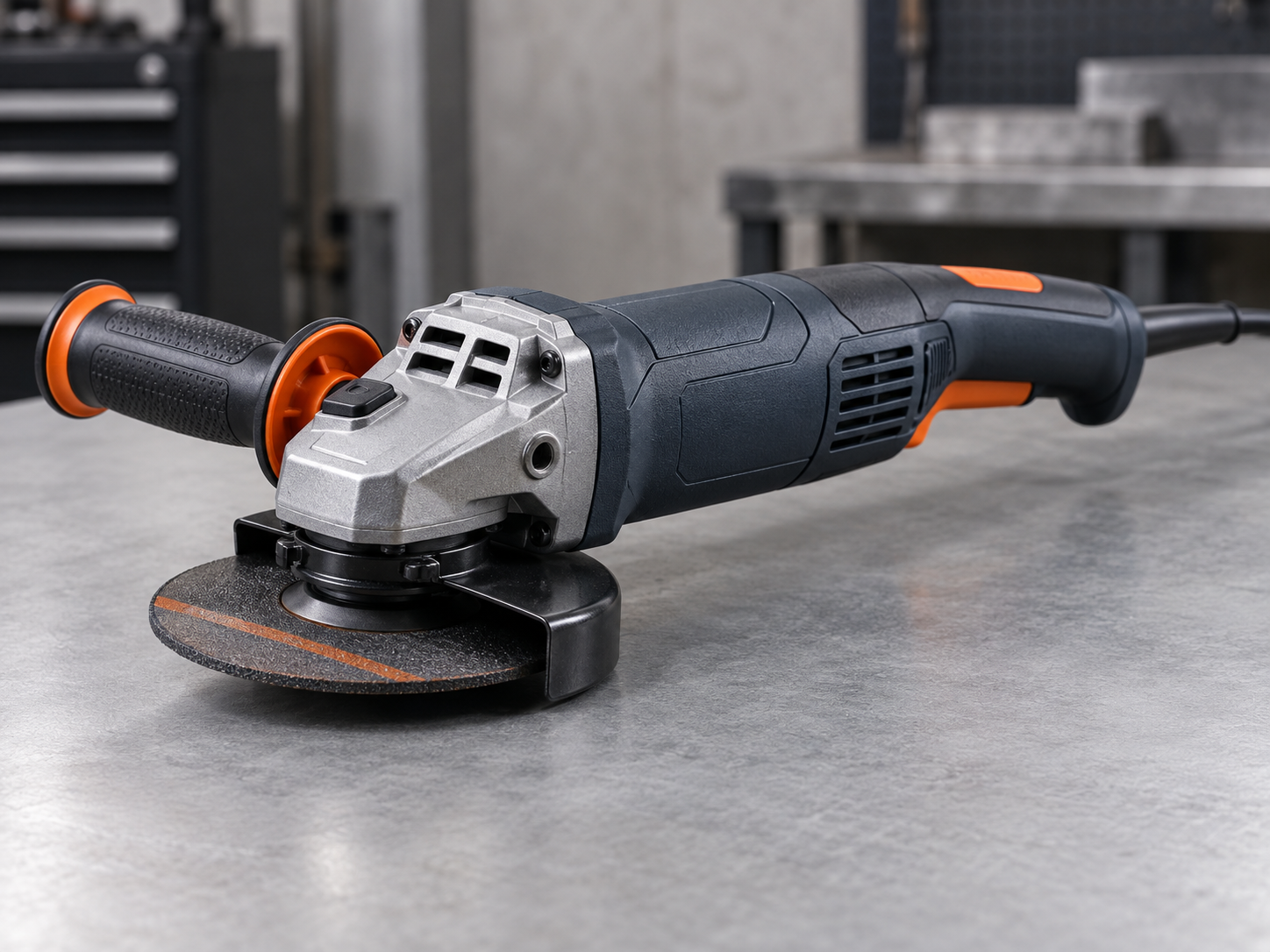
Caption: Shroud, wheel, guard and hose connection should be checked as one approved setup.
Check the mechanical mounting
Inspect the proposed grinder's gearbox-neck or guard-mount geometry and the shroud's clamp. Confirm the exact model and revision; a small casting change can affect fit. Assemble the accessory with the tool isolated, following both manufacturers' instructions. The shroud should seat fully, stay fixed in the permitted orientation and not rely on improvised tape, extra washers or a forced clamp.
Check the approved wheel's clearance through the entire permitted adjustment range. A rotating wheel must not contact the shroud, brush skirt or dust port. Verify that the side handle can be installed and gripped as intended and that the switch remains accessible. A hose routed across a hot area or near moving parts may make an otherwise mechanically compatible kit impractical.
Ask whether a separate guard is needed or whether the shroud itself is designed and approved for the operation. Do not remove a required safety guard merely to make a third-party accessory fit. The user's manual should describe the allowed configuration. A photo of the shroud attached to a generic grinder is not evidence that it is approved for every model.
Check the extraction path
Record the dust-port outside diameter, hose inside diameter, adapter part number and method of retention. A loose press-fit connection can detach under normal movement. A reduction adapter may appear convenient yet restrict flow or pull the hose into an awkward angle. Test the complete hose route on the intended work surface, not just with the grinder suspended in the air.
The dust extractor itself must suit the dust and task under applicable instructions and rules. Ask for its relevant filtration, airflow, filter-cleaning and collection information. Do not assume a household vacuum is an acceptable substitute. If the product is sold without an extractor, state the required characteristics and compatibility process clearly enough that a trade buyer can select one.
Consider maintenance: brush skirts and seals wear, hoses clog, filters load and collection containers fill. A kit that performs well only with brand-new consumables may disappoint quickly if replacements are unavailable. Ask for the shroud's spare parts, service instructions and replacement intervals where specified. This is part of total cost, not an optional afterthought.
Build a controlled sample trial
Use trained personnel and the maker-approved grinder, wheel, shroud and extractor in a controlled work area. Define the substrate, task, number of passes, work position and operator. Inspect the assembly before power is applied. Observe whether the shroud stays seated, the hose remains connected, dust escapes at edges, and access to corners or workpiece transitions is acceptable.
A visual comparison can reveal obvious fit problems but cannot quantify worker exposure. If a buyer intends to claim compliance or dust reduction, commission the appropriate task-specific assessment. The supplier can provide product evidence and a demonstration, but the workplace user must still apply local controls. Avoid “100% dust free” claims; even a well-designed system can release dust during starting, edge work, emptying or maintenance.
Record the wheel and shroud part numbers, extractor model, hose and filter condition, workpiece, photos and observations. If an accessory is substituted after sample approval, rerun the relevant fit and application checks. A shroud that fit one wheel profile may rub another. The supplier change-control guide offers a process to keep these decisions visible.
Mid-article sourcing CTA: Assembling a surface-preparation grinder kit? Send the grinder model, wheel, material and extractor interface for a compatibility review.
Make the buyer specification unambiguous
The quotation should identify every included component: grinder body, guard or shroud, wheel, hose adapter, handle, wrench, instructions and case. If an extractor is not included, state that plainly. A photo with a vacuum in the background can create a misleading impression of box contents. List compatible model revisions rather than only a broad brand name.
For a private-label programme, confirm artwork and warnings reflect the actual kit. The shroud may need an installation diagram, cleaning guidance and a clear statement of approved operations. Market-specific requirements should be reviewed by the importer. Do not rely on a generic insert from an unrelated tool when a modified kit changes the setup.
At shipment inspection, sample finished kits and physically confirm shroud part, clamp hardware, adapter, wheel and manual. Inspect packaging to see that a protruding dust port is protected in transit. A kit can pass a tool-body functional test yet arrive with a cracked shroud or missing adapter, preventing the customer from using the dust-control arrangement sold.
Handle complaints without masking the hazard
If a customer says the shroud “does not collect dust,” ask about model fit, wheel, extractor, hose, filter state, workpiece and operation. A blocked filter and a loose clamp require different actions. If dust is escaping heavily or a wheel is contacting the shroud, stop use and assess the setup; do not ask the user to continue testing while filming the problem.
Trend returns by kit SKU and accessory lot. Several missing adapters point to packing control; repeated hose detachment may indicate a design or tolerance issue; complaints only on edge grinding may reveal an application limitation that should be disclosed. The response should revise the product or its guidance, not merely refund isolated cases without learning.
Retail training should avoid shortcuts such as “fits all 125 mm grinders.” Diameter alone is not a mounting interface. A short compatibility table with exact models and parts is more valuable than a universal-fit promise. It can also reduce the number of returns incorrectly attributed to the grinder motor.
Create an exact compatibility matrix
The buyer's matrix should list grinder model and revision, mounting diameter or interface, approved wheel and guard, shroud part, hose adapter and tested extractor configuration. Mark each combination as approved, untested or rejected. “Fits 115–125 mm grinders” is not a substitute. Even within one brand family, gearbox necks and guard locks can differ.
Use a physical sample to confirm each approved row. A paper dimension can be correct while an external switch, ventilation slot or handle blocks installation. Photograph the assembled tool from several angles and retain the specific accessory labels. This record helps warehouse staff, sales teams and customer support answer a compatibility question without repeating the original engineering meeting.
If a third-party shroud maker supplies a new revision, do not silently reuse the old row. Check the clamp, skirt, wheel clearance and adapter again. The revision history should say what changed and which finished kits received it.
Evaluate edge work and cleaning
Many shrouds have a movable segment or opening to approach a wall edge. If the design permits it, test that position separately because dust capture and guard coverage can change. Do not show the shroud held open in a marketing photograph without explaining the approved operation and controls. A kit optimized for broad flat surfaces may not be equally effective in corners.
Maintenance should be demonstrated in the sample review. Can the operator identify a blocked port or worn brush skirt? Can a service partner obtain the correct replacement? What is the safe procedure for cleaning the hose and collecting the dust? A shroud that only works with a pristine filter can lead to “extractor too weak” complaints after a short period of real use.
Record observations as functional fit and visible dust behavior, not an exposure reduction percentage unless a valid measurement supports one. If a customer needs a regulated dust-control method, involve the relevant specialist and document the whole system under the applicable rules.
Decide who owns each part of the offer
An importer might buy the grinder from one factory, the shroud from another and the extractor from a third. One party still needs to own system compatibility. Define who approves the assembled kit, who maintains the matrix, who updates the manual and who investigates a field complaint. Without ownership, each supplier can truthfully say its individual part passed while the customer receives a kit that does not work together.
For a retailer selling the shroud separately, place the compatibility table near the purchase decision and include a route for checking uncertain models. For a bundled kit, the full assembly should be verified at pilot production and sampled at shipment. The commercial boundary—what is included, required or optional—must be as clear as the mechanical one.
A sample approval record for the full assembly
The record should name the grinder, shroud, wheel, hose, adaptor and extractor, with part numbers and revisions. Include non-powered fit photographs, wheel-clearance check, permitted guard arrangement, workpiece and a short functional observation. If any component was borrowed from a demonstration kit rather than the intended bill of materials, mark it clearly and close the gap before production release.
Do not call an assembly “compatible” because the clamp closes once. The shroud should stay fixed through the maker-permitted adjustment range and normal task movement, while switches and handles remain accessible. The hose should not detach when the operator changes position. A small, well-designed trial can reveal those issues without making an unsupported exposure claim.
The record should also state what was not evaluated, such as a different wheel diameter or an extractor sold by the customer. This boundary prevents sales staff from turning one approved setup into a universal-fit promise.
For multi-market offers, keep a fit record by exact grinder model, shroud part number, wheel type and permitted diameter. A visual similarity between housings is not proof that clamp geometry, handle clearance or guard position is unchanged. Ask the factory to notify the importer when a gear-head casting, clamp or spindle arrangement is revised, then repeat the fit check on the changed configuration.
Extractor compatibility needs its own row. Record the hose or adapter size, the tested extractor and any specified airflow or filtration requirements from the applicable equipment instructions. If the customer supplies a different extractor, the retailer can describe the connection dimensions but should not transfer the tested dust-control conclusion to the new system without evaluation. This makes the compatibility statement narrow, useful and defensible.
Frequently asked questions
Can any shroud fit any grinder of the same wheel diameter?
No. Mount geometry, guard design, wheel clearance, handle position and hose route differ. Verify the exact model and accessory combination under the makers' instructions.
Is a shroud alone enough to control concrete dust?
No. It is one component of a system that may include an appropriate extractor, hose, filtration, maintenance and work practices. Applicable workplace rules must be assessed for the specific task and location.
Should a buyer remove the grinder guard to make a shroud fit?
Do not improvise a setup that conflicts with the tool or shroud instructions. Ask the manufacturers to identify the approved guarding arrangement. If the proposed parts cannot be safely combined, choose another combination.
What should shipment inspection verify?
Verify the exact shroud, mounting hardware, adapter, wheel, instructions and protected packing against the approved kit. A quick physical fit check on a sampled finished unit can catch more than a carton count.
Conclusion
Dust-shroud compatibility is a system decision. The buyer must verify mounting, wheel clearance, hose and extraction path, approved operation and the finished retail kit. A clear, bounded compatibility claim is more useful to contractors than a broad “universal dust-free” label.
Send your requirements
Share the grinder and wheel models, dust-generating task and intended extractor. ToolViron can discuss a controlled accessory-fit and sample-review plan for your range. Send your requirements to begin.

Caption: The approved dust-control kit should be verified as a complete saleable configuration.
Images illustrate product and inspection topics; they are not documentary evidence of a specific ToolViron test or customer project. Confirm the exact model and market requirements before ordering.